The Story of the 1964 Phillies Press Guide
 by Bob Warrington
Today, Media Guides are an indispensable source for background information about a baseball team, its players and officials, organization, statistical records (both good and bad), ballpark, franchise history, and other reference material. Originally produced by clubs as Press Guides exclusively for members of the media—primarily newspaper writers and broadcasters with daily responsibility for baseball coverage—they are now called Media Guides, published in large numbers, and made available to the public for purchase.
By the early 1960s, all Major League baseball teams produced Press Guides except the Philadelphia Phillies. The task of convincing the club to do so fell upon Larry Shenk who, in October 1963, had been hired by the Phillies as the team’s Publicity Director. I interviewed Shenk about his experience, and here is the story he relayed to me about the creation of the Phillies first Press Guide.
“In early 1964,” according to Shenk, “I approached Phillies’ executives about producing a Press Guide for the team. All other Major League teams had one, and I thought the Phillies should as well. It simply didn’t look good that we were the only club without a Press Guide. I was told, however, that producing a guide was ‘too expensive,’ and my proposal was turned down.” Undaunted, Shenk decided to produce one “on the cheap” for the 1964 season.
“I initially wanted a professionally printed Press Guide with glossy covers similar to those published by other clubs,” Shenk recalled, “but when the club rejected my idea as prohibitively costly, I knew I’d have to come up with a less expensive alternative.” So, without asking anyone’s permission, Shenk decided on his own to compile, write, design, print, collate and distribute mimeographed copies of a 1964 Press Guide for the Phillies. Working on a bare-bones budget, the guide would have to be stylistically plain with no photographs, but it would gain the unique status of being the first one ever issued by the Philadelphia Phillies.
Shenk typed by hand a master stencil for each page of the guide, fitted the stencils one at a time around the mimeograph machine’s inked drum and produced multiple duplicate copies of each page. A laborious task was made even more onerous by the fact that two pages of the guide could be typed onto a single stencil. This was economical, but every copy mimeographed from each stencil had to be cut in half by hand to separate the two pages. The requirement to cut each mimeographed page in half also explains the guide’s unusual dimensions of 4 ½” x 8 ½”.
With the mimeographed pages of the guide printed and cut, Shenk now faced the grueling task of collating and binding all of the pages for each of the guides. The enormity of the job can be measured by the fact that 300 copies of the 1964 Press Guide were published and each guide consists of 58 pages. Shenk remembered with a wry smile his living room being covered with pages of the guides as he and his wife, Julie, collated the 17,400 pages of the 300 copies. Each copy was bound by having two holes drilled into it and metal posts placed into the holes.
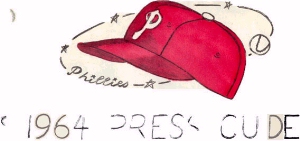
To make the guide’s cover at least somewhat bright, Julie hand-colored each one. The cover shows the classic team logo from the period—a Phillies cap with an orbiting baseball and star—along with the words, “1964 Press Guide.” The red coloring on every Phillies cap that appeared on the 300 copies of the guide is courtesy of the artistic talent and remarkable perseverance of Julie Shenk.
When asked why he decided on 300 copies of the guide, Shenk admitted that he couldn’t remember how he settled on that figure. He hastened to point out that media coverage of baseball teams was far different in 1964 than it is today. “We had three sportswriters covering the Phillies fulltime in 1964—Allen Lewis of The Philadelphia Inquirer, Ray Kelly of The Evening Bulletin, and Stan Hochman of The Philadelphia Daily News. During that period, each of the sportswriters kept their own statistics, as did broadcasters including Byrum Saam, (the Phillies legendary broadcaster who’s enshrined in the Hall of Fame). “Other newspapers in the Philadelphia region relied primarily on wire service copy to report on the team,” according to Shenk.
With the precedent of a Press Guide established, the Phillies published a professionally printed guide in 1965 and have done so every since. “I simply had the guide printed in 1965 without asking anyone’s permission.” Shenk stated. “It simply got done.”
Although crude by contemporary standards, the 1964 Phillies Press Guide is a delightfully appealing publication that exudes far more charm and individuality than today’s mass-produced and somewhat sterile Media Guides. What computer-generated graphic on a contemporary media guide could possibly match the simple elegance of the hand-colored Phillies cap on the 1964 Press Guide?
As an artifact, the 1964 Press Guide is highly prized among Phillies collectors. Not only is it the first Phillies guide, it is also associated with the ill-fated—yet still-beloved—team that came so close to winning the 1964 National League Pennant. Finding a copy of the guide for sale is next to impossible. Writing in Phillies Report in 1989 (Vol. 7, No. 17, 5 October 1989) about collectibles from the 1964 Phillies team, memorabilia columnist Max Silberman wrote (p. 22):
Perhaps the crown jewel of 1964 collectibles is the 1964 press guide. At a time when few such guides existed, Larry Shenk proved to be a real pioneer and hand-produced a press guide which was printed in limited quantity. The covers were hand colored by Shenk’s wife Julie, and only a few of the estimated 300 copies are still in existence. The last one sold at a memorabilia show changed hands for nearly $600.
A renowned collector of Phillies memorabilia, Silberman acknowledges never being able to acquire a copy of the 1964 Press Guide for his collection, and he estimates that there are “less than a dozen copies” still in existence.
With only 300 copies of the 1964 Phillies Press Guide produced, it’s not surprising that the publication is extremely scarce. Such guides, moreover, are designed to have a shelf life of one year. For most recipients, once a club issues its new media guide, the previous year’s edition is tossed away as obsolete. In addition, back in the mid-1960s, guides were not generally perceived as pieces of memorabilia that should be preserved for their historic and monetary value.
During my interview with Larry Shenk, he couldn’t recall what had happened to the 300 copies of the 1964 Press Guide. “Copies were placed on a table in the press room at Connie Mack Stadium,” Shenk remembered, “and reporters—both local and those who accompanied teams visiting to play the Phillies—took what they wanted.” It remains unclear how many of the 300 copies were left over after the season or what became of any that did remain. They may have been thrown out or simply left behind when the Phillies abandoned Connie Mack Stadium after the 1970 season. If the latter, then they were probably consumed by the fire that devastated the stadium in 1971, or perhaps were later destroyed when the stadium was demolished. Shenk still has a copy of the 1964 Press Guide in his office at Veterans Stadium that he has no intention of parting with.
Determining a current estimated value for the 1964 Phillies Press Guide is extremely difficult since so few appear on the market. A reference point is Silberman’s notation that one was purchased for $600, but that was over 12 years ago. Almost assuredly, the price has risen significantly since then and is now somewhere in the four-figure range…if you can find one.