The Phillies Leave Baker Bowl
 By Bob Warrington
Now happily ensconced in state-of-the-art Citizens Bank Park, the Phillies are three ballparks removed from the archaic confines of Baker Bowl (officially known as National League Park). Citizens Bank Park, however, will have to be around a long time to surpass the Phillies’ relationship with their ballpark at Broad and Huntingdon Streets.
The team called the location home for 51 and a half seasons, far surpassing its time at Shibe Park/Connie Mack Stadium—31 and a half years—and Veterans Stadium—33 years. At their current ballpark, the Phillies are at two years and counting.
Of course, there were two ballparks at the Broad and Huntingdon Streets site. The first one—called Philadelphia Ball Park—was built in 1887 and lasted until 6 August 1894 when it burned to the ground. The Phillies opened the most modern ballpark of its time on 2 May 1895, and the team would call the place home until mid-way through the 1938 season. Although best remembered for its decrepitness, National League Park was once the most advanced ballpark in the United States. William F. Baker, after whom the ballpark was named unofficially, was a penurious owner who believed he should not have to invest any of his own money in the ball club when he ran it from 1913-30. His successor, Gerald P. Nugent, who owned the Phillies from 1932-43, never was financially positioned to modernize, let alone keep up, Baker Bowl. The old ballpark simply deteriorated over time and earned the scorn of players, sportswriters, other team owners, and fans.
Rick Westcott, in his excellent book, “Philadelphia’s Old Ballparks” (Temple University Press, 1996) notes that the Phillies tried for years to get out of Baker Bowl to move down Lehigh Avenue to Shibe Park and become tenants of the Philadelphia Athletics. As early as the late 1920s, he writes, it was thought the Phillies would leave Baker Bowl. But the team could not break a 99-year lease with Charles W. Murphy, who had taken control of the ballpark when a new ownership group purchased the Phillies in 1912. When Murphy died in 1932, negotiations were begun to terminate the lease, and an agreement was finally reached that enabled the Phillies to abandon Baker Bowl.
Even in its last days, however, Baker Bowl was the scene of some noteworthy events. In the Phillies’ last Opening Day at the place on 19 April 1938, Brooklyn Dodger outfielder Ernie Koy hit a homer in his first major league at bat in the top of the first inning. Phillies second baseman Emmett Mueller came right back in the bottom of the first to hit a home run in his first big league time at bat.
The final Phillies game played at Baker Bowl took place on 30 June 1938. The team took on the New York Giants and got walloped 14 to 1. This may have been symbolic payback for the 19 to 10 drubbing the Phillies administered on the Giants when the two teams played the first game ever at Broad and Huntingdon Streets on 30 April 1887.
The Phillies were a perpetually awful team in the 1920s-30s, and the move down Lehigh Avenue didn’t help matters much. Playing its first home game at Shibe Park on 4 July 1938, the team finished the season in the all-too-familiar position of last place, posting a 45-105 record, and finishing a remarkable 43 games behind the first place Chicago Cubs.
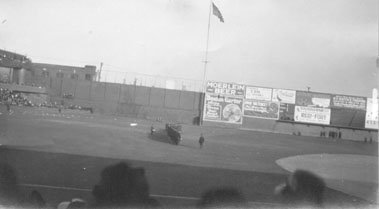
Because of its cozy rightfield wall and the inviting right-center power alley, Baker Bowl was often referred to as a “cigar box” and “band box.” Its hitter-friendly dimensions led to some amazing batting feats of prowess. In June 1923, the New York Giants scored in each of the nine innings—4, 2, 1, 1, 5, 5, 1, 2, 1—of a game to trounce the Phillies 22-5. In October 1929, on the last day of the season, Phillies outfielder Lefty O’Doul got six hits in eight times at bat in a doubleheader against the Giants to raise his league-leading batting average to .398 and set a National League record for hits in a season, 254.
Longtime Phillies outfielder Chuck Klein batted an extraordinary .359 during his six prime years with the club (1928-33), leading the league in hits twice, in doubles twice, and in home runs four times. Nevertheless, because he played in “tiny” Baker Bowl, skepticism over the significance of his numbers kept Klein from election to the Hall of Fame until 1980.
The clubhouse at Baker Bowl was located in straightaway centerfield, joining the leftfield bleachers to the rightfield wall and slanting between the two. These connections created crazy angles and alleys, especially on the rightfield side where the clubhouse met the wall, making it difficult to play caroms of balls bouncing around in that area. The problem was compounded for a number of years by a banked 15-foot wide warning track (actually a bicycle track) that rimmed the outfield. Outfielders had to run up an incline to catch some long fly balls. No ball was ever hit over the clubhouse in centerfield, but in 1929, Rogers Hornsby hit a home run through one of its windows—the window being closed at the time.
The terrible condition of Baker Bowl and the mostly bad Phillies teams that played there starting in the late teens should not obscure the importance of the ballpark in baseball history, and the fact that it was home to some fine teams, including a National League pennant winner, up through the mid-teens. In an anecdote-filled loving tribute to Baker Bowl that was written by Edward F. “Dutch” Doyle and appeared in “The National Pastime” (Number 15, 1995, pp. 24-31), Doyle wrote:
“Philadelphia’s Baker Bowl is remembered today as a comical bandbox of a park, inhabited by bad Phillies teams with worse pitching. In fact, it was the first modern ballpark, it was the home grounds for pretty decent teams during its early years, and it didn’t gain the name by which we all know it until a quarter century after it was built.”