The 1913 World Champion Athletics – Part I
 By Bob Warrington
Introduction
1912 was a bad year for the Philadelphia Athletics. With back-to-back world championships in 1910-11, most baseball observers thought the A’s were odds-on favorites to win their third title in a row.
Connie Mack certainly believed his team would repeat as champions, and so did his A’s players. Instead, the Athletics got their comeuppance. Playing lethargically with a “We’ll win when we have to,” mentality, the A’s got off to a slow start and never got on track. Mack would later call the 1912 Athletics his “greatest team ever,” but also note sadly about it, “If ever a club suffered from overconfidence, it was my 1912 team.”
Writing in his autobiography, “My 66 Years in the Big Leagues,” almost 40 years later, Mack lamented, “My first great disappointment came in 1912. Two straight pennants and two World Series victories made my boys feel they couldn’t lose…This gave our boys a feeling of cocksureness that invariably results in a tumble. Maybe I, too, was too complacent, and thought the boys would step up the pace.” But, the months passed and the surge toward victory never materialized. The A’s still won 90 games in 1912, but finished in third place, a full 15 games behind the Boston Red Sox.
Mack took the lesson of 1912 to heart. He realized it wasn’t a lack of talent that had cost the A’s the pennant; it was succumbing to the temptations of complacency and overconfidence. Mack would not allow another Athletics team to lose because its players could not arouse themselves enough to win. Things would be different in 1913.
All the Team’s Men
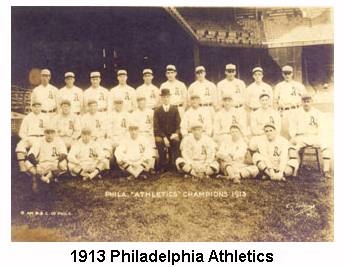
The 1913 Athletics team reflected both continuity and change. The “$100,000 infield” of Stuffy McInnis, Eddie Collins, Jack Barry, and Frank Baker remained intact from the 1910-11 championships. The $100,000 figure signified that the combined talents of the A’s infielders were “beyond value.” The Athletics outfield, by contrast, had evolved. Rube Oldring still anchored centerfield, but Bris Lord had left the club after the 1912 season and Danny Murphy-nearing the end of his playing days—appeared in just 40 games. Eddie Murphy and Jimmy Walsh flanked Oldring as regular outfielders in 1913. Amos Strunk continued to play an important part as a reserve outfielder, toiling for the team in 80 games.
If there was a question mark for the Athletics in 1913, it was in their pitching. The veteran duo of Eddie Plank and Chief Bender formed the foundation of the staff. Jack Coombs, however, contracted typhoid fever at spring training and was lost for the season. Another veteran, Cy Morgan, had dropped to a record of 3-8 in 1912 after several productive seasons as a pitcher with the A’s. He would not be with the club in 1913. The bulk of the pitching chores would rest on the shoulders of a cadre of younger pitchers, all of whom were relative newcomers to major league baseball. Two of them, Carroll “Boardwalk” Brown and Byron “Duke” Houck had pitched respectably for Mack in 1912, compiling 13-11 and 8-8 records, respectively. Three other pitchers who saw limited action in 1912—Stan Coveleski, “Bullet” Joe Bush, and Herb Pennock—would be back to toil on the mound for the A’s. In addition, pitcher Bob Shawkey, acquired from the minor league Baltimore Orioles franchise in mid-season, would make a valuable contribution during his time with the club.
A transition behind the plate also was underway for the A’s. Dependable Jack Lapp handled most of the catching chores in 1913, as he had in 1912. However, 1913 marked the debut of Wally Schang for the Athletics, and he wound up catching almost as many games as Lapp did that year. Schang would develop into a first-rate player, take over as the team’s regular catcher in 1914, and remain with the club in that capacity through the 1917 season. Many regard Schang as Mack’s greatest catching discovery, next to Hall of Famer Mickey Cochrane, of course.
Then, there was Connie Mack himself. After the 1912 season, Mack bought the shares of Frank Hough and Sam Jones—two sportswriters who had owned 25 percent of the Athletics’ stock since the club’s establishment. With these additional shares, Mack owned 50 percent of the club and the ballpark, guaranteeing his continued allegiance to the Athletics. This pleased Ben Shibe, principal owner and club president, who wanted to ensure that his manager would not be lured away to take the helm of another team. In 1913, Connie Mack could begin to cash in on his increased investment in the Philadelphia Athletics.
Spring Training
The Athletics held their spring training camp in San Antonio, Texas in 1913. A new psychology permeated the camp as Mack worked his players harder than he had in the past and reminded them incessantly that lackadaisical play and smug attitudes had cost the A’s the pennant the previous year.
The 1913 Season
Connie Mack adopted a new pitching system for the A’s that would prove crucial to success in 1913. In addition to starting Eddie Plank and Chief Bender, he often used them as relievers in games in which younger starters held the lead but were beginning to tire. This was a calculated gamble on Mack’s part since both Plank and Bender had been pitching for the Athletics for over a decade and were, by 1913, on the downhill side of their illustrious careers. Mack acknowledged the risk when he wrote later in his autobiography, “Bender and Plank I used oftener than any manager had ever used two pitchers. I would put one of my youngsters in the box to start a game and then I would send Bender or Plank in to save it.” With reliever’s duties added to his starting pitcher’s role, the number of games in which Bender appeared jumped from 27 to 48 between 1912 and 1913. Plank—always a workhorse on the A’s staff—climbed more modestly, from 37 to 41.
The system worked splendidly. The Chief won 21 games in 1913, six of which were gained in relief, while Plank brought home 18 victories for the Mackmen, four of which were earned as a reliever. Writing in the “Sporting News,” Billy Weart praised Mack’s strategy. He commented, “To this writer’s way of thinking, Connie never performed a greater achievement than he has this season (1913), when he has his team leading the race from the start with only two veteran pitchers, Plank and Bender, and a number of youngsters who have been taken off the rubber more frequently than they have been able to go through an entire contest.”
The 1913 pennant race was not much of a race after all. The Athletics squelched any suspense in the American League chase by moving into first place in late April and never relinquishing the position. A 15-game winning streak during the season helped the Athletics maintain the lead. The “$100,000 infield” performed superbly, with McInnis, Collins, and Baker all hitting over .300, and Baker leading the league in home runs (12) and RBIs (117). The three regular outfielders all hit respectably—Murphy at .295, Oldring at .283, and Walsh at .254. As a reserve outfielder, Strunk batted a commendable .305. Leading the pitching staff was Bender with 21 wins, followed by Plank (18), Brown (17), Houck (14), Bush (14), and Shawkey (8). Pennock won only two games for the Athletics in 1913. His Hall of Fame pitching career lay in the future with another team.
Cleveland, behind the prolific bat of ex-A’s player Joe Jackson, stayed close to the Athletics for the first three months of the season. The Indians could never quite catch the A’s, however, and eventually wound up in third place. The Washington Senators landed in second at season’s end, largely on the magnificent performance of Walter Johnson, who went 36-7. Nevertheless, the Athletics’ 96-57 record gave them a comfortable six-and-a-half-game lead over Washington when the regular season concluded.
Awaiting the Philadelphia Athletics in the 1913 World Series was their old nemesis—John McGraw and his New York Giants.
The 1913 World Champion Athletics – Part II
By Bob Warrington
The Triumph of the White Elephant!
1913 was the rubber game of the match between the A’s and Giants. The Giants had outdistanced the Athletics four games to one in the 1905 World Series, and the A’s got the best of the Giants four games to two in the 1911 Fall Classic. Mack, as he had in the 1905 and 1911 World Series, gave the ball to Chief Bender for the first game. While the Chief wasn’t as effective as he had been in previous World Series appearances, giving up eleven hits and four runs, it was still enough to best Rube Marquard and the Giants. Frank Baker hit a home run with Collins on base and Schang inserted a timely triple. The A’s knocked Marquard out of the box in the fifth inning on their way to a 6-4 victory.
The second game featured Eddie Plank against the Athletics’ post-season bete noire—Christy Mathewson. It was Mathewson who pitched three shutouts in six days against the A’s in the 1905 World Series. The Mackmen, however, exacted some revenge against Mathewson in the 1911 Fall Classic—beating him two out of three games. Plank was a hard luck pitcher in the World Series, winding up with an overall 2-5 record during his time with the A’s. The second game of the 1913 World Series was indicative of Plank’s misfortune. For eight and one-half innings Plank and Mathewson fought each other to a scoreless draw. In the bottom of the ninth, the Athletics had men on second (Barry) and third (Strunk) with no one out. Mack thought the game was a good as won. Two successive grounders to first base, however, resulted in Strunk and then Barry being thrown out at home plate. A grounder back to Mathewson ended the A’s aspirations and sent the game into extra innings. It didn’t last long. The Giants got to Plank for three runs in the top of the tenth and won 3-0. For Plank, it was his third World Series shutout suffered at the hands of the Giants and the second by that score to Mathewson.
The third game of the World Series saw the Athletics’ bats come alive. Mack started one of the youngsters—Joe Bush—who held New York to five hits and two runs. The A’s, meanwhile, scored eight runs as Collins and Baker made five hits between them and Schang unloaded a mighty home run.
Game Four again saw Chief Bender at less than his best, but just good enough to win. The A’s spotted him a 6-0 lead at the end of five innings, but the Giants came back to threaten in the sixth. With two men on base, McGraw called on Moose McCormick to pinch hit. McCormick hit a sinking liner to centerfield, and in what Connie Mack later called “the greatest catch I ever saw in a World Series,” Rube Oldring came in fast and snared the ball in a diving, tumbling catch just when it was about to touch the ground. The significance of the catch became more apparent when the Giants scored five runs in the seventh and eighth innings to come within one of the Athletics. Bender, however, ended the game convincingly by setting down New York in order in the ninth. Mack, in a classic understatement, noted to the Chief when the game was over, “Albert, you surely had me on pins and needles for a while.”
Game Five offered a reprise of the Plank-Mathewson match-up. In a rare development, the Athletics got to Mathewson early, going up 3-0 by the end of three. Plank, pitching a masterful game, allowed the Giants only a solitary run in the fifth, as the Mackmen glided to a 3-1 win and the World Series title. Plank had gained his measure of satisfaction in the last World Series game ever played between the Philadelphia Athletics and New York Giants.
Aftermath
A celebration was held in Philadelphia that included a parade in which the A’s made the three-mile trip from Shibe Park to the Bellevue-Stratford Hotel with the public lining the streets to cheer on their heroes. All seemed well for Connie Mack and his World Champion Philadelphia Athletics. But, it wasn’t. At the end of the 1913 season, the Federal League, an independent minor league circuit, announced that it was expanding to major league status and would fill its ranks by raiding the rosters of American and National League clubs. Not surprisingly, the A’s would be a prime target of the raiders. The move would bring Mack’s First Dynasty to an end, lead to the dismantling of the A’s team, and ensnare the club in controversy that remains to this day. 1912 may have been Mack’s greatest disappointment,” but 1914 would be his bitterest.
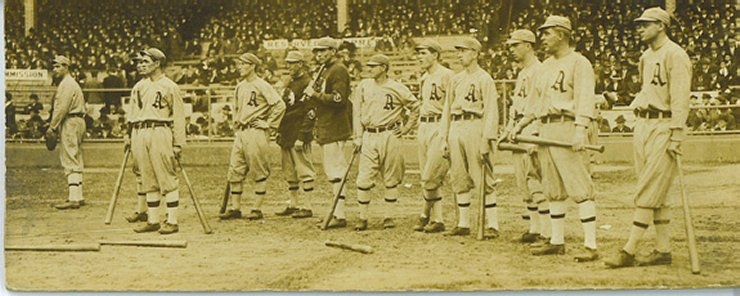
Photo taken at Polo Grounds in New York during the 1913 World Series