Thomas “Pap” Paprocki — Rembrandt of the Sportspages
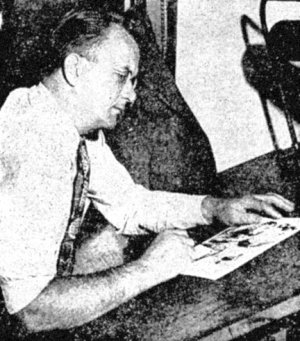 by Ronnie Joyner
During the first half of the 20th century, a period when newspapers thrived because television had yet to take over as the dominant means by which Americans got their news, sports cartoonists thrived, some reaching levels of popularity usually reserved for the athletes that they illustrated.
By the mid-1940s one sports cartoonist with the peculiar moniker of “Pap” had separated himself from his crowded field through his very popular nationally syndicated illustrated column SPORTS SLANTS by PAP. Sports fans may not have known why, but they recognized artistic greatness when they saw Pap’s art in their sportspages every day. It started with Pap’s dynamic composition, strong black linework, dead-on player likenesses, and subtle use of gray tones to add dimension to his work and bring it to life. Add to that his clever and stylish spot-cartoons that peppered the perimeter of his drawings and you had the formula for success that saw Pap entertain sports fans for nearly 40 years.
Years before Pap became one of the rare celebrities known by merely one name, he was born Thomas P. Paprocki in New York in 1902. As a boy, his attraction to illustration led him to take his first art lesson at the age of nine from a landscape artist who had set up his easel along the waterfront at Pap’s native Bay Shore, Long Island. His interest in drawing continued through grade school and high school, but at the same time he developed a love of athletics. As a sprinter specializing in the 440-yard run as well as competing in the shot put for the Loughlin Lyceum team of Brooklyn, Pap got noticed by Fordham University during track and field competition against them in the early 1920s. They offered him an athletic scholarship, but he declined, opting instead to take a job at a Brooklyn department store where he could hone his artistic skills by attending art classes at night.
Pap credited his boss at the department store for being very instrumental in helping him land his first newspaper job shortly thereafter. The man used his contacts to help Pap get in with the NEW YORK AMERICAN’s art staff, promising the burgeoning young artist that he could “come back here if you miss.” Pap’s days in the department store business may have been over, but he had yet to give up on his athletic endeavors. During his early years with the NEW YORK AMERICAN, Pap would from time to time, as one writer put it, ³edge toward the side door, shoot a quick glance toward his toiling colleagues, and disappear. Two hours later, at some suburban field meet, he’d turn up in track shoes, shorts and a shirt of the Loughlin Lyceum team, to run himself ragged in the sprints, and tear his drawing arm loose in the shot-put.”
This covert athletic activity finally came to an end one day when Pap, pulling his usual side-door fade-out, was caught by his boss. “Look, son,” Pap’s boss said, “don’t you think it’s about time you decided whether you’re going to be an artist or an athlete?” Apparently Pap took the hint and hung up his track and field spikes and picked up his paint brush in earnest. Pap gained valuable experience while at the NEW YORK AMERICAN in the mid-20s, but he was also got invaluable direction from an unlikely source — George Daly, famed sports editor of the NEW YORK WORLD. For a couple of years Pap sent Daly sample illustrations and columns. Daly would edit the stories, critique the drawings, and return them. Pap often credited George Daly’s input as a vital element in his climb to the top of the sports cartoonist field. So impressed was Pap with Daly’s unselfish assistance to a no-name kid that Pap himself would continually perform the same service for young kids who wrote him seeking advice.
Pap’s diligence began to pay off big in 1932 when he was approached by the Associated Press about going to work for them. He accepted their offer and soon began producing a daily sports cartoon and an accompanying sports column that ran continually for 35 years until his retirement. His popularity reached its zenith in the late 1940s when he became acknowledged as the nation’s number one sports cartoonist as his work reached millions of readers throughout the United States, Canada and Latin America, as well as U.S. Soldiers stationed the world over through the U.S. Army’s STARS AND STRIPES.
The 1940s Pap was described as a “broad-shouldered, hearty, congenial fellow with a year-round tan and an addiction to brown sports coats, brown shirts, brown slacks and elaborate practical jokes. At work he hunches over a drawing board at the head of Rembrandt Row at AP Features in Rockefeller Center, and if he gets behind in his work it’s because he cheerfully interrupts it a dozen times a day to gab with a stream of visitors. His sports participation is now confined to golf, and when he lays his 200 pounds into a drive, the ball travels like it had come out of a bazooka. He’s good enough to have won the New York Baseball Writers’ trophy several times.”
Pap had a reputation for quickness in executing his illustrations, but he always put in a considerable amount of research time before ever laying pencil to paper. “Research consumes a major portion of the time,” he once said. “Drawing the cartoon is more or less a mechanical process that takes four or five hours after all the materials have been gathered. It takes plenty of leg work and a lot of scratching to dig up interesting material. I do depend on help from our bureaus all over the country to get the national coverage the AP service demands. Contacts with graduate managers at the colleges and with sports promoters help provide material. But for the most part, it’s simply a case of keeping on top of the sports news and following up leads and hunches.”
The subjects of Pap’s illustrations ranged from the most obscure amateur athlete to the greats of professional sports — and everyone imaginable in between. It was the amateur subjects, however, with whom Pap had the most affection. “I have a warm spot in my heart for amateur athletics — especially the school and college brands,” he once said. “I make a point of seeing all the minor basketball, baseball, swimming and boxing events possible, for it is from these beginnings that the stars of the future develop. I get a kick out of spotting a youngster who shapes up as a prospect and then watching him develop. My interest in pro sports is only lukewarm. I have no patience with — and less interest in — watching fading athletes continue far beyond their prime. Comebacks bore me. On the other hand, the developments of a champion in any sport excites me. After all, the real purpose of sport is to develop and improve the youngsters.”
Despite Pap’s self-admitted “lukewarm” interest in pro sports, his lack of enthusiasm did not show itself in the quality of his work, which was outstanding regardless of the subject matter. Pap’s medium of choice was ink (he was a master at the dry-brush technique) and black crayon on Ross board — a pebbly-surfaced paper that was designed to convert the soft tones of Pap’s shading into camera-ready art. That meant that his artwork did not have to be halftoned when being prepared to go to press. It allowed his art to reproduce crisply and cleanly with great contrast in newspapers which were notorious for reducing tonal photographs into mushy, flat, soft images that lacked sharpness and contrast. In basic terms, Pap’s art simply looked better in print than photographs of the real action.
Pap created thousands of drawings over the course of his long illustrious career. His originals are highly sought after by sports art collectors and occasionally turn up at auctions where they fetch top dollar. Countless numbers of his originals, however, have remained in the possession of the subject of the illustration, or another member of the family in the incidences where the original athlete has passed away. Pap quickly discovered that no matter how famous the sports hero — no matter how many trophies and other accolades the athlete may have accumulated — they always enjoyed Pap’s drawing of them, and many would ask him for the original. By 1946, a point in time when it was estimated that Pap had done over 6,000 illustrations, he speculated that he had given at least one-quarter of his originals to the individual sketched.
Occasionally an athlete was disappointed when seeking Pap out for an original, usually because it had already been claimed by some other lucky person. Such was the case with one of the most famous ballplayers to ever step on a big league ballfield — Lou Gehrig. The story goes that an AP office boy wrangled a Pap original featuring Gehrig and subsequently asked Alan Gould, then an AP sports editor, to get the Iron Horse’s autograph on it. Gould, armed with the Pap artwork of Lou, later approached Gehrig at Yankee Stadium and asked him to sign the piece. Gehrig was so taken with the piece that he asked Gould if he could have it. “Nothing doing,” Gould supposedly said. “This’n is for the office boy. Pap can draw you another original!”
Pap continued strong through the 1950s and 60 before retiring from his job at the AP in 1967. He lived in Atlantic City, New Jersey, and showed an affinity for West Point where his son had been a cadet. Murray Olderman, a legendary sports cartoonist in his own rite, recenty offered a few comments on Pap. “Pap was certainly an influence on me, for his fine draftsmanship and precise technique,” Olderman said from his home in Rancho Mirage, California. “I became aware of his work in the old NEW YORK SUN late in the 1930s and 40s. And when I moved to New York to work for NEA in 1952, I had the pleasure of meeting him and getting to know him through the years as a genial companion. We saw each other frequently in sports gatherings in New York over the years, and he was always affable — there was never a sense of rivalry, though we worked for competing syndicates. I still have a couple of his originals, one dedicated to my son, and I also have an oversized, folded broadside, showing examples of both his art and accompanying text that was put out by AP features to market his sports cartoons.
Six years after he retired, Pap passed away in Atlantic City on January 4th, 1973. His life’s work has to this point inexplicably failed to be gathered into a comprehensive retrospective, so for now you’ll have to resign yourself to enjoying his work in old sports magazines and newspaper clippings. One day, hopefully, Pap’s artwork will again be available for the masses — just like it was in the golden age of sports cartooning.
“Pap” was a friend of my mother and dad. I’m not sure how that came about but I was interested to learn from your article that he originally came from Bayshore, LI. Our home was in Amityville, LI about 20 miles away and perhaps they became acquainted through some common friend or interest.
In any event Pap would come out from the city or NJ to our home with his wife and,later, his young son, 2 or 3 times a yearto spend the day. I was about about 10 or so (now 83). I would badger him to “please draw a picture for me” and he would oblidge. He would use one of those black wax pencils where you unrolled the paper to expose the tip when it wore down. It was like watching a magician! A face would emerge from the paper, then a cap, a shoulder and then a mane just under the face followed by a horses head and in just a moment or two there would be a an image of a jockey and his horse driving for the finish line with every muscle straining. I worshiped him. I collected his pictures every evening from the the Brooklyn Eagle (?) I can’t recall with certainty which paper it was — and kept them in a scrap book which I still have. I treasure that scrap book and every now and then I go back through it — Chalkey wright, Bill Owens, Steve Lak, Count Fleet, and on and on. Thanks for you lovely piece above. Sincerely, Bill
I grew up in Brooklyn NY in the 30s and 40s. I was an avid baseball fan. We got the New York Sun delivered every day and I started clipping out Paps sports incredible characterizations. I have more than 50 of these and plan to put them up for sale on EBAY soon.