Shibe Park’s Scoreboard
 By Bob Warrington
When Shibe Park opened in 1909, it was hailed then, and is justly remembered now, as the first of a series of classic ballparks that dominated and symbolized Major League baseball in the 20th century. Shibe Park reflected the apex of modern technology, as it was then understood, from reinforced concrete in its construction to a garage beneath the rightfield stands in recognition of the increasing role cars were playing as a mode of transportation.
The exterior structure of Shibe Park—highlighted by the domed tower of the main entrance at 21st Street and Lehigh Avenue—remained a fixture on Philadelphia’s landscape for most of the 20th century. But, as Rich Westcott notes in his outstanding book, “Philadelphia’s Old Ballparks,” significant changes were made to Shibe Park over the years. The ballpark’s scoreboard was affected by and indicative of the evolution of Shibe Park.
The First Two Scoreboards
A ballpark scoreboard in the early 20th century was a rudimentary device, simplistic both in purpose and operation. It bears as much resemblance to a contemporary scoreboard as the Wright Brothers’ Kitty Hawk aircraft of that same period bears to today’s Boeing 747. The first Shibe Park scoreboard was intended to provide information only on the game being played there. Players did not wear numbers or names on their uniforms at that time, so the scoreboard numbers assigned to players were based on a player’s place in the batting order for the game. This principle also applied to scorecards. Other pitchers and substitute players received numbers higher than nine.
Photos of Shibe Park’s first scoreboard show that it listed “Philadelphia” and Visitor.” Below each category were nine rectangular spaces in a vertical line to exhibit the lineups of the teams—players’ names, positions on the field, and in the batting order. Just prior to the game, lineups were placed on the scoreboard as a man was announcing them with a megaphone, first notifying the crowd behind home plate, and then repeating the names down the first- and third base lines. Atop the lineups section were two horizontal series of squares, again differentiated by “Philadelphia” and “Visitor,” with each set of squares having numbers above them to identify the first through ninth inning. These squares showed the number of runs scored by the teams in each inning. Added squares at the end of each row showed total runs, hits and errors for each team.
Where was Shibe Park’s first scoreboard located? A photo of the World Champion Philadelphia Athletics taken in 1911—two years after the ballpark opened—shows the players and manager Connie Mack lined up on the edge of the outfield grass between second and third base. Clearly visible down the third base line is the scoreboard at the corner of the leftfield wall where it meets the grandstand. Photos of the ballpark from the same period showing other sections of the outfield wall, grandstand, and bleachers confirm that there was a single scoreboard at Shibe Park and that it was situated in the leftfield corner.
It didn’t stay there long. In 1913, the first major alterations were made at Shibe Park. They included adding bleachers across the outfield wall from the leftfield corner to the flagpole in center. The addition necessitated a new location for the scoreboard, and the only logical place for it to go was along the rightfield wall, which ran parallel to 20th Street and contained no seats for spectators. It was the site chosen.
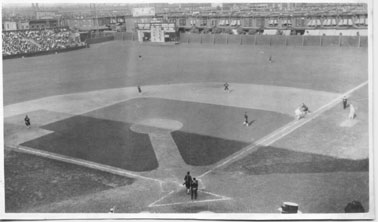
The new scoreboard was appreciably larger than the original model—both higher and wider—and was located along the wall in right centerfield. A photo taken at Shibe Park in 1913 pinpoints the location of the scoreboard. (The photo ran in Issue #48 of the A’s Society newsletter and is reproduced here for this article.) In addition to showing the dimensions and location of Shibe Park’s second scoreboard, the photo reveals some important characteristics about its function and operation.
The scoreboard had an “American League” section on its left and a “National League” section on its right. Both sections list the lineups and by-inning tallies for “Philadelphia” and “Visitor.” The “American League” section, of course, was devoted to the Athletics, while the “National League” section applied to the Phillies, who were playing at National League Park. Since both teams often played games on the same day, the Athletics apparently used the scoreboard to keep their fans at Shibe Park apprised of the progress of Phillies’ games being played just six blocks down Lehigh Avenue. The information from National League Park probably was telephoned to Shibe Park for display on the scoreboard.
The 1913 photo also illustrates the somewhat surprising fact that the scoreboard operator stood at the base of the scoreboard during the game and used a ladder and poles to update developments. The photo, taken during a game in progress between the A’s and White Sox, clearly shows a person at the base of the scoreboard with a ladder and poles leaning against a corner of the scoreboard. (The quality of the photo as it appears in this newsletter is not of sufficient quality to identify these features clearly, but they are visible on the original photo.) The photo does not reveal, unfortunately, if the operator updated the score as runs crossed the plate or waited until the conclusion of each half inning.
Standing on the field of play, the scoreboard operator had to pay particular attention to the game in order to stay clear of any balls hit to deep centerfield and to avoid interfering with the play of outfielders, especially the centerfielder. The 1913 photo makes clear, nevertheless, that Shibe Park’s second scoreboard did not have a gangplank or catwalk behind it from which an operator could hang numbers and other information to update game developments.
There is other interesting note about Shibe Park’s first two scoreboards that is worth mentioning. Both, at their very top, had “Score Board” prominently displayed. (At that time, scoreboard was spelled as two words, as was baseball.) One can only wonder why the Athletics felt the need to identify the scoreboard for fans. What else could it possibly be?
Like Shibe Park’s first scoreboard, the second one didn’t last long. Photos of the right centerfield wall taken in the mid-teens show that the scoreboard had been removed by that point. We can only speculate as to why. Perhaps having the operator on the field and using a ladder and poles to update information on the scoreboard was deemed impractical, or worse, a distraction by players—both in the outfield and at the plate. Regardless of the reason, the evolution of baseball scoreboards would soon take a major leap forward.
The Age of Electricity
According to Edward White in his book, “Creating the National Pastime,” the builders of Yankee Stadium “revolutionized” baseball in the 1920s by constructing a huge electric scoreboard in right centerfield. Like older hand-operated scoreboards, the Yankees’ new scoreboard gave the lineups for both teams, along with players’ positions on the field and in the batting order, the inning-by-inning score of the game, and the cumulative total of runs, hits and errors. In addition, however, the Yankee Stadium scoreboard provided a list of all other games in progress in the Major Leagues that day, complete with scores and the name of the pitcher toiling for each team. And, it was all operated by electricity, with numbers and letters flashing out of a black background.
The Athletics, however, were not inclined to embrace the marvels of an electric scoreboard. In 1941, almost 20 years after the Yankees had introduced their electronic scoreboard, a new hand-operated scoreboard was added to Shibe Park along the rightfield wall. It was located approximately at the mid-point of the wall because the area where the 1913 scoreboard had been—right centerfield—was now occupied by an enormous stanchion installed in 1939 to hold some of the lights used to illuminate the ballpark for night games. While the 1913 scoreboard towered over the rightfield wall, the wall dwarfed the 1941 scoreboard. That was because the rightfield wall had been raised from 12 feet to 34 feet in 1935 so that people sitting on 20th Street could no longer view games for free from their rooftops.
As Rich Westcott points out in his book, the 1941 scoreboard had a gangplank inside of it from which operators hung numbers to track the progress of the game. The numbers appeared mysteriously on the scoreboard, placed there by anonymous operators doing their job unseen by the ballpark’s fans. That scoreboard stayed at Shibe Park during the remaining years that the Athletics called the place home.
Fittingly, the last major change to Shibe Park—by now called Connie Mack Stadium—came in 1956 and involved the scoreboard. As Westcott notes in his book, the 1941 antiquated scoreboard was finally removed, and a 50-foot-high electric scoreboard was incorporated in the stadium. Ironically, the Phillies purchased the scoreboard from the New York Yankees—the first team to have an electric scoreboard—when the Yankees bought an even newer one. The “new” Phillies scoreboard was located at the approximate mid-point of the rightfield wall and towered over it. Its two most distinguishing characteristics—other than being Philadelphia’s first electric scoreboard for baseball—was the Ballantine Beer advertisement that ran its length and the Longines clock that perched at the very top. This scoreboard marked the passage of time at the ballpark until it, along with what was left of Connie Mack Stadium, succumbed to the merciless pounding of the wrecking ball in 1976.