Rev. Aloysius Travers, S.J.: The Hawk who Became a Tiger for a Day
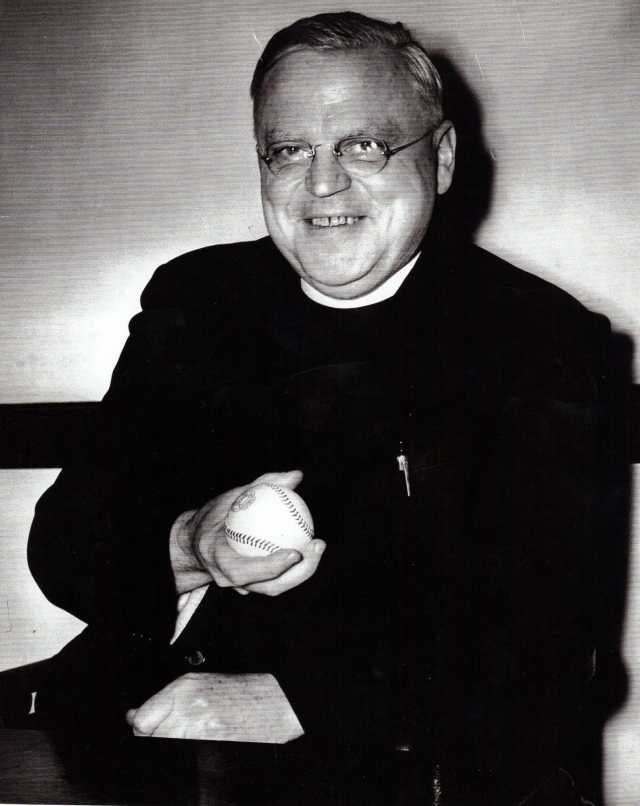 By Dick Rosen
Several months ago, Ernie Montella, the Executive Director of the Phila. A’s Historical Society was accosted in a supermarket by an elderly man while both were in line at the checkout. The shopper caught a glimpse of Montella’s A’s cap and his T-shirt, which featured a logo of the Society. Taking this as a free pass to ask any question he pleased about the A’s, the shopper said, “I’ve got a trivia question for you. I bet you never heard of my former English teacher, Father Travers.” Before the cashier could scan his box of Wheaties, Montella had begun to tell the man, and others who had gathered, that not only had he heard of Travers, but he knew the amazing story of Father Aloysius (Allan) Travers, S.J. and his 1912 “cup of coffee” with the Detroit Tigers.
On May 18, 1912, Allan Travers made his first, and only, appearance as a pitcher for the Detroit Tigers. At the time, he was a 20-year-old student at St. Joseph’s College, had played little baseball, and certainly had never pitched. Travers’ “fifteen minutes of fame” came as a result of an incident which had occurred in New York three days earlier. On May 15, at Hilltop Park, an ugly event involving Ty Cobb and a handicapped New York Highander fan who was heckling the Detroit outfielder, led to the suspension of the “Georgia Peach.”
Dick Rosen a native of south Philly attended high school in Ellwood City, Pa located near Wampum Pa, the hometown of Phillies favorite Dick Allen. He & Dick & Hank Allen played on opposite American Legion teams during their early years. Currently Mr Rosen, a 1963 graduate of Drexel University is currently completeing his 40th year and is a history professor at this same prestigious Pennsylvania college.
That event in New York has been retold many times, but the gist is that Cobb was suspended “indefinitely” by American League president, Ban Johnson (who coincidently was attending the game) for going into the stands to pummel the heckler, Claude Lueker. To make matters worse, Lueker had been handicapped several months earlier in a work-related accident; he had lost one hand and three fingers of the other in a printing press accident. Lueker had been trading insults with and taunting Cobb with profanity and “racial slurs.” Cobb even tried to find Frank Farrell, Highlander Club President, to have the fan ejected from the stadium, but Farrell was not around. Goaded by fellow players Cobb finally lost control and went into the stands after Lueker.1 His teammates, most of who disliked Cobb, did not agree with his suspension, and to a man, supported Cobb’s actions and demanded that the suspension be revoked or they would not play another game.
Johnson refused to revoke the suspension at that time and the players stuck to their guns. This was clearly the first strike in baseball history2, but it was now Johnson’s move. He threatened Tiger owner Frank Navin with a $5000 fine and a forfeit of every game not played. Navin, afraid of losing his AL franchise, insisted that his manager, Hughie Jennings, get a team together in any way possible. Jennings appealed to a Philadelphia acquaintance, Joe Nolan, a Philadelphia Bulletin sports writer, to help him out. Nolan had met Allan Travers, the assistant manager (not a player) of the St. Joseph’s baseball team when the A’s “Yannigans” played an exhibition game against the St Joe’s team earlier that spring. At Nolan’s behest, Travers, a twenty-year-old junior from North Philadelphia recruited most of the eight potential Tigers from his neighborhood; six were “sandlotters,” two were amateur boxers. Each was to be paid $25 for their services.
On Saturday, May 18 at 2:30 PM, the official Tiger team took the field. Cobb, however, was immediately waived off the field by the umpire, and the rest of the Tigers, gathering their gloves and sweaters, left with him. Jennings now called to the bleachers where the “recruits,” waiting to don their Tiger uniforms and to sign their “one-day” contracts were sitting. They believed they only had to go onto the field, the game would be called off, and they would collect their fees. Seeing the crowd of 20,000 (some say only 15,000), Connie Mack decided that the game must be played. After all, why lose all those gate receipts? And what about his players’ opportunity to increase their individual stats? Mack’s reigning World Champions were determined to play the game for real.
In addition to the local recruits gathered by Travers, Jennings also pressed two of his coaches into service. James Thomas “Deacon” McGuire, 48 at the time, had played twenty-five seasons for twelve different teams in the NL (three years with the Phillies), the AA and the AL. Most of his activity was as a catcher, although he also played some outfield and infield; he even was a relief pitcher for one day with Rochester Hop Bitters of the American Association where he compiled a 6.75 ERA in four innings of work. McGuire had also been a manager for six years and was in his first of six years as a coach for the Tigers when he was called on to play in this famous game. Indeed, by playing in this game McGuire broke a record for most seasons in the major leagues, 26. (By the end of his career, Eddie Collins had only 25 seasons and McGuire’s record would be only eclipsed in 1993 by Nolan Ryan with 27). “Deacon” had even served as a substitute umpire in the NL (during four seasons) and the AL (during one).
The second Tiger coach was Joe Sugden, 41, a Philly native, who had spent twelve years in the majors, mostly with the Pirates and the Browns, as a first baseman and catcher. Sugden, who had last played in 1905, would be at first for this game; McGuire would do the catching.
The real story, however, is Allan Travers. Travers had never played any serious baseball before this day, but was a musician of sorts. He was very active in musical organizations at St.Joseph’s and his mother had dreamed that he would one day be a violinist with the Philadelphia Orchestra. When Joe Nolan was contacted by Hughie Jennings, the reporter immediately went to Travers for help. Allan knew some players from his 23rd and Columbia haunt where he rounded up his recruits. Only two of them looked much like ballplayers, Bill Maharg and Ed Irvin. Maharg was a boxer, born William Joseph Graham (just reverse the letters) who also played one game with the Phillies in 1916 (lifetime BA, .000) and was later implicated as a “bagman” in the 1919 Black Sox scandal.
Ed Irvin, then a sandlot player in Philadelphia, had played Class D and C minor league ball (unaffiliated) for five years (1903-4, 1909-11) mostly as a catcher. In this game, Irvin was to hit two triples in three ABs and, to this day, holds a slugging avg. of 2.000, and OPS 2.667. Unfortunately, he died four years later in a barroom brawl.
Bill Leinhauser, more a boxer than a ballplayer, had the misfortune of playing center field and wore the uniform of Ty Cobb. Rumor has it that when his wife discovered that he had the gall to replace the inimitable Cobb, she hit him with a skillet. Other suspicions revolve around Pat Meaney, allegedly 41 and a native Philadelphian. For years, he was considered the oldest rookie in MLB history until Satchel Paige, at 42, debuted in 1948. Meaney’s record has been corrected in the baseball annals within the past few years to show that he was actually Vincent Maney from Batavia, NY. Born in 1884, he was only 25 at the time of the celebrated game. His fear of being discovered as a scab, led him to disguise his real identity. He went 0 for 2, with three putouts, three assists, and an error.
Travers was to have played right field, but when Nolan told him that the pitcher was to be paid double (probably $50), the St. Joe’s student decided he would pitch. Interestingly, Travers managed a complete game (8 innings), giving up 24 runs (still a record), only 14 earned, for an ERA of 15.75. He apparently threw a slow curve consistently, but when he attempted his only fastball to Frank Baker, the A’s third sacker hit it over the right-field fence. However, since it curved foul after leaving the park, it was called a foul ball, not a homer, in accordance with the rules in those days. After the Baker blast, Joe Sugden (it may have been Jennings) went to the mound for a conference. According to Red Smith in an obituary of Travers, Sugden said, “Do you want to get killed. Just throw your regular stuff. It ain’t good enough to hit.” 3 Maybe Sugden was right. After four innings the A’s were ahead only 6-0. But when the “misfts” got two runs in the fifth on two consecutive singles by Sugden and McGuire followed by an Irvin triple, the A’s began to feel the pressure. Perhaps a bit embarrassed by the closeness of the game, the Athletics began to bunt on Travers, scoring eight runs in the fifth inning. With a defense loaded with former boxers, inexperienced infielders, and several out-of-shape catchers, wild throws were rampant. As the A’s bunted, the “Tigers” threw wil dly. From that point on, fans in the lower level seats along first base found themselves in a “combat zone,” often ducking the errant throws from Tiger fielders. Jennings also reportedly told his outfielders to forget about catching fly balls and “just play them off the walls.” 4
The Athletics were serious about this game, seeing it as an opportunity to fatten up their personal statistics. Eddie Collins, 4 for 6, stole five bases on McGuire’s 48-year-old arm; McInnis went 4 for 6 with a triple and two stolen bases. Indeed, the A’s had ten stolen bases, four doubles and six triples, but not a single home run. To his credit, Travers even chalked up a single strikeout, apparently against a red-faced Jack Barry, the A’s shortstop. Hughie Jennings also saw an opportunity to boost his stats and went in as a pinch hitter for Travers in the ninth. Jennings, the Hall of Famer who hadn’t played seriously since 1903, did not get a hit but increased his number of years played statistic by one.
The following day, Travers’ photo was seen in the local newspaper under the headline, “Strikebreaking Pitcher.” His mother was sure he would receive a visit from local “goons” because of the great sympathy for union members in his neighborhood. At the time, city transportation workers were on strike and scabs, of course, were not very popular. Travers, however, was unharmed. In fact, one of the results of this game was the eventual formation of a short-lived players union (Baseball Players Fraternity) organized the following August. Some 288 players signed on as of Sept. 6, 1912, when the group was incorporated in New York City. Officers included, David Fultz (player turned lawyer), President, and board members Christy Mathewson, Jeff Sweeney, and, of course, Ty Cobb. The group endured until 1917.
Another upshot of the game was a new set of rules allowing umpires to eject abusive fans from the stadium. Grantland Rice, in particular, called for such action. In a Sporting news article5, Rice decries the raw language heard at ballparks and observes that baseball was becoming a more proper game attracting wives and children who should not be exposed to rowdy fans and uncontrolled players. Rice was also concerned that Cobb never had a chance to defend himself.
Cobb’s suspension was eventually reduced to five days and his fine to only $50. The remaining Detroit players were fined $100 each. When President Navin said he would pay all fines, Ban Johnson refused to allow it; he wanted each player to bear his own responsibility. There was some fear of Cobb’s returning to New York, where his victim, Claude Leuker, was considering a lawsuit. It was also rumored that gangsters were looking to square counts with the Tiger outfielder. But Cobb was also praised by the entire Georgia Congressional delegation (two senators and 10 representatives); “We commend your action in resenting an uncalled for insult. We hope for your complete exoneration and speedy restoration to a place in the clean sport of baseball. We are proud of your record as a leader in your profession.” Such were the attitudes of the times.
After his abbreviated baseball career, Allen Travers was ordained Rev. Aloysius Stanislaus Travers, S.J. in 1926. He then taught at St. Francis Xavier High School in New York before becoming Dean of Men at St. Joseph’s College. In 1943, and for the next 25 years, until his death on April 21,1968, he served on the faculty at St. Joseph’s Prep, his high school alma mater. He remains the only ordained Catholic priest with major league service.