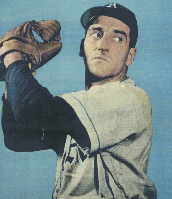
Phil Marchildon of the Royal Canadian Air Force
 by David M. Jordan
Born in 1913 in Penetanguishene, Ontario, a small town on an inlet off Georgian Bay, Phil Marchildon grew up to be the ace of the postwar Athletics pitching staff. It was not an easy climb for Phil, and his tenure at the top was to be all too brief, its brevity occasioned in part by his wartime experiences.
Of French-Canadian stock, although he spoke only English, Marchildon was raised in relative poverty in Penetang. Still, he considered his childhood a happy time, with his three brothers and three sisters, playing whatever games were available, and delivering the Toronto Star to help the family finances.
Marchildon never played baseball until high school, but when he started it was clear that he had a real talent for the game. He thrived as a pitcher on a town team, although he had little idea where the ball was going when he let it go. The young man subsequently took a job with Creighton Mine, in a town west of Sudbury, where he worked in a nickel mine and pitched semi-pro ball for the local team.
Eventually one of Marchildon’s former hometown coaches arranged for him to try out with the Toronto Maple Leafs of the International League, and the young fastballer impressed manager Dan Howley enough to win a contract.
Phil Marchildon started his professional baseball career in the spring of 1939 with Toronto, at the advanced age of 25 years old. After a brief stint at Cornwall in the Canadian-American League, Marchildon returned to Toronto and pitched well enough in 1939 and 1940 that his contract was purchased by the Athletics for a September callup and two big league games at the end of the ’40 season.
In 1941 and 1942, Marchildon established himself as a regular starter on last-place Athletics teams, with records of 10-15 in ’41 and 17-14 in 1942. Coach Earle Brucker took the unpolished young pitcher in hand, smoothed out his motion, and improved his control. Marchildon, grateful for Brucker’s help, never warmed to Connie Mack, regarding him primarily as a tight-fisted employer who would not pay him what he was worth, and he was particularly embittered that Mack did not even say goodbye to him when he left for military service after his fine ’42 season.
Marchildon, a proud Canadian, joined the Royal Canadian Air Force, turned down opportunities to play service baseball or to be a physical trainer, and instead became a tail-gunner in a Halifax bomber attacking Adolf Hitler’s Festung Europa. Flying out of a base near the Yorkshire village of Skipton-on-Swale, Marchildon and his crew had successfully completed twenty-five missions when their plane was shot down on the night of August 16, 1944. Fished out of the North Sea by two Danish resistance fighters, Marchildon and a fellow crew member were captured by the Germans when they reached shore.
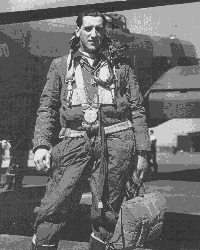
Eventually sent to Stalag Luft III, the prison camp 105 miles southeast of Berlin from which the famous “Great Escape” had been made seven months earlier, Phil Marchildon was an unwilling guest of the Third Reich until he was liberated by a British patrol on May 2, 1945. For several months before that happy event, he and his fellow prisoners were marched around Germany in an effort to keep them away from approaching Allied forces. Far out of baseball condition, underweight, and suffering from nervous attacks, Marchildon returned to Penetang to regain his health and get married.
Summoned back to the Athletics early in July, Marchildon had no expectation that he would pitch during the ’45 season, and Brucker, the pitching coach, agreed. But Mister Mack planned a Phil Marchildon Night, with the returned pitcher as the A’s starter, and Marchildon reluctantly went along. Before a crowd of 19,000 fans, he pitched five decent innings before injuring his leg, as might have been expected. After another abortive start a few days later, Marchildon’s ’45 season came to a close.
In 1946, however, Phil Marchildon, now 32, regained his spot as the A’s number one pitcher. With a bad team behind him, Marchildon, using a sizzling fastball, good curve, and occasional forkball, won 13 and lost 16, with a 3.49 earned run average. The next year, with Eddie Joost and Ferris Fain added to his supporting cast, Phil was superb, posting a 19-9 and 3.22 record. With the Athletics in the first division most of the year before slipping to fifth place in September, Marchildon was now recognized as one of the American League’s premier moundsmen.
In 1948, as the Mackmen made a legitimate run for the pennant, however, Marchildon was a great disappointment. A nervous condition lingering from his prison camp experience sapped his strength and he was not able to produce as he had done in the past. A record of 9 and 15 testified to his loss of effectiveness. The next season arm troubles - probably an undiagnosed torn rotator cuff, Marchildon later believed - reduced him to sixteen bad innings in seven games. At the end of spring training in 1950, the Athletics sold Marchildon to Buffalo, where he lost five games before being released. In July he hooked on briefly with the Red Sox, but after one unimpressive outing he was dropped. Another comeback effort with Toronto in 1951 also ended in failure.
His baseball career ended, Marchildon returned to Canada and his home town. Disappointed by the hand fate had dealt him, Marchildon brooded. Like so many professional athletes, he was not prepared for the workaday world facing him when his baseball days were done. Finally, with the help of friends and his wife, Marchildon pulled his life together and found work as an expediter in an aircraft plant and, later, with a manufacturer of hospital furniture outside of Toronto.
In 1976 Marchildon was elected to the Canadian Sports Hall of Fame and in 1982 to the Canadian Baseball Hall of Fame. He published his memoirs in 1993, and on January 10, 1997, at the age of 83, he died. While his baseball career started late and was sadly shortened, Phil Marchildon was justly proud of the recognition that came to him in his native land, the land for which he had gone to war.
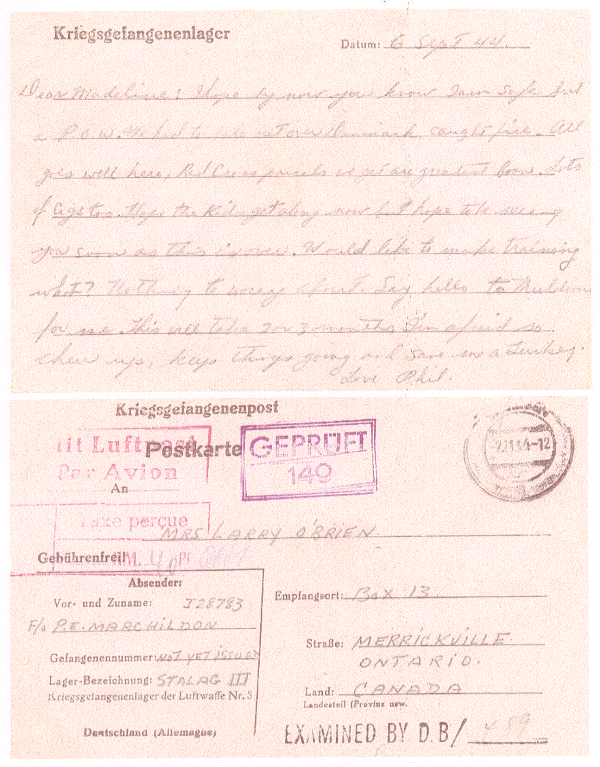
Below is a letter from Phil that he wrote while being held as a Prisoner of War. Please read our interpretation of this letter while it downloads, it will take a few seconds to load.
Dear Madeline: I hope by now you know I am safe but a POW. We had to fade out over Denmark, caught fire. All goes well here, Red Cross parcels we get are greatest boom. Lots of cigs too. Hope the kids get along now but hope to be seeing you soon as this is over. Would like to make training with ? Nothing to worry about. Say hello to Muldoon for me. This will take 2 or 3 months i’m afraid so chin up, keep things going and save me a Turkey.