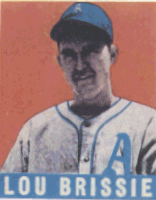
Lou Brissie
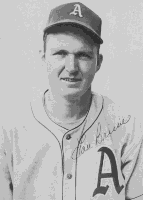 Baseball history is filled with examples of men who overcame huge obstacles to play the national pastime. One of them was most definitely a lefthanded pitcher named Lou Brissie.
Brissie did his best work with the Philadelphia Athletics during a seven-year career that wound up with the Cleveland Indians. He did it despite a shattered leg that had nearly been blown off during World War II.
Lou, whose real first name is Leland, not only survived that injury, which required 23 operations and earned for him two Purple Hearts and a Bronze Star, he came back to win 30 games over a two-year period in the big leagues and at one point was considered one of the top southpaws in the American League.
The baseball career of the 6-4 1/2, 210-pound native of Anderson, South Carolina, was almost dashed on a battlefield in the Appennine Mountains near Florence, Italy while he was serving with the 351st Infantry. Brissie was hit with German artillery shell fire on his way back to the front lines in December 1944. If he had been six feet closer, he would have been killed.
As it was, the shell broke Brissie’s feet and shattered his left leg, which was split open from the ankle to the knee. Also hit in the right shoulder with mortar fragments, Lou had to crawl for cover through the mud, and in the process bacteria lodged in the wound.
Rushed to a field hospital, he was given emergency treatment. What followed was an odyssey that would take him to scores of hospitals in Europe and the United States.
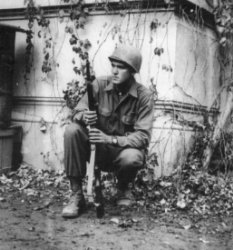
“Basically, they had to reconstruct my leg with wire.” Lou says. “I wound up going to hospitals all over. I was the first guy in the Mediterranean Theater who was put on penicillin therapy. I even smelled like penicillin, I had so much of it.”
After returning to the United States, Brissie finally got out of the hospital in August, and visited Philadelphia in September 1946, to check in with the team that had originally signed him in 1942.
His condition was a big concern of the A’s. In 1942, they had gone to great lengths to sign the strapping lefthander, sweetening the pot to get him after he was spotted playing on the sandlots of Greensville, South Carolina.
“Chick Galloway, an old shortstop (primarily in the 1920s with the A’s), had brought me to Philadelphia in 1941, the day I finished high school,” Brissie remembers. “I met Mr. (Connie) Mack, and agreed to sign with him. At that time, I played first base as much as I pitched, and I signed as both.
“I wanted to go to college, so Mr. Mack gave me three options. I could go to Duke where his old pitcher, Jack Coombs, was the coach. I could go to Holy Cross where his old shortstop, Jack Barry, was the coach. Or I could go to Presbyterian College where Galloway was the coach. I chose Presbyterian, and Mr. Mack sent me there for two years.”
Brissie was scheduled to report to the A’s for spring training in 1943, but the war prevented that from happening, and he didn’t get to his first spring training until 1947.
After going to West Palm Beach with the A’s that year, Lou was sent to Savannah where he posted a 23-5 record with a 1.19 ERA. He struck out 278 in 254 innings, and gave up just 167 hits. Brissie led the South Atlantic League in wins, ERA and strikeouts.
Osteomyelitis had settled into Brissie’s leg, however, and it would give him trouble the rest of his career.
“It’s a bacterial infection of the bone marrow,” Brissie explains. “If it gets into the blood, it can kill you. But I was always able to control it with antibiotics.”
The A’s brought up Brissie at the end of the 1947 season. He started the only game in which he pitched.
“It was in Yankee Stadium on the first Babe Ruth Day,” Lou recalls. “Honus Wagner, Ty Cobb, Tris Speaker-all the great players I had read about-were there. You talk about a guy not being in the real world. I thought I’d died and gone to heaven. I lost the game, 5-2, but it was a great occasion.”
The following spring, Brissie was back in training camp with the A’s. This time, he not only made the club, he was a starter on opening day.
“We were in Boston,” Lou remembers. “They opened the season with a Patriots Day doubleheader, playing both a morning and an afternoon game. Phil Marchildon pitched the first game.”
In the second game, Brissie pitched a sparkling four-hitter to beat the mighty Red Sox, 4-2, even though in the seventh inning Ted Williams lined a drive off Lou’s bad leg, sending him crashing heavily to the ground. As he lay in agony on the field, surrounded by worried players and coaches, Brissie looked up and saw a distraught Williams-himself a war hero-anxiously peering down at him. “For Chrissakes, Williams, pull the damn ball,” Brissie barked. Eventually, Lou arose, and after a few tentative warmup pitches, completed not only the inning but the game.
Lou had many other banner days in 1948. While the A’s made a solid run at the American League pennant, even holding down first place in mid-August before finally finishing fourth, Brissie had a 14-10 record. Owner of a crackling fastball, a sharp curve and a deceptive change-up, he was fourth in the league in strikeouts with 127, while working in 39 games.
“I worked awful hard to get to that point,” Brissie remembers. “I had a lot of therapy. I did a lot of walking. My leg was wired together, and part of my ankle was gone-even today it bends only 30 percent of what it should.”
“The injury changed my pitching style. I couldn’t throw as hard or with as much control as I did before. I threw stiff-legged. But I just tried to work around such things. Some days I hurt and some days I didn’t. I just looked at it day to day. I knew I was realizing a dream that I had for a long time. And I enjoyed every minute of it.”
“It was especially enjoyable playing for those A’s teams back in the late 1940s,” Brissie says. “We had a pretty good pitching staff with Marchildon, Dick Fowler, Joe Coleman, Bill McCahan, Carl Scheib and later Alex Kellner and Bobby Shantz.”
“We were a club that enjoyed playing together. We had a lot of fun and a lot of togetherness. All of us believed we could win. Mr. Mack called it the finest club he ever had from the standpoint of giving effort. If you took us position by position, very few people would pick us. But as a group, we did very well together.”
While the 1948 A’s finished fourth, 12 1/2 games behind the Cleveland Indians, who won the pennant in a one-game playoff with the Red Sox, the 1949 A’s figured to be just as good. Instead, they wound up fifth, 16 games behind the front-running Yankees.
Brissie, however, had another splendid season, although he missed most of September when the osteomyelitis flared up in his leg. Not only did he carve out a 16-11 record, he was named to the American League All-Star team. Lou pitched the middle three innings, giving up five hits, including a two-run homer to Ralph Kiner, in his team’s 11-7 victory over the National League at Ebbets Field.
“I was like a kid in a candy shop, just sitting on the bench with all those guys like Williams, Lou Boudreau and Joe DiMaggio,” Brissie says. “To pitch in the game was an added thrill.”
Pitching against Williams, DiMaggio and the other great stars of the league was a special thrill for Brissie, who worked with a protective guard over the lower part of his left leg.
“It was always tough pitching to them,” he says “But the big mistake you had to guard against with them was letting guys batting in front of them get on base.”
The 1950 A’s were starting to show signs of deterioration. Coleman, Fowler, Marchildon and McCahan were all lost with arm trouble. In Mack’s final year as manager, the club finished a distant last, losing 102 games and ending up 46 games out of first place.
Brissie’s season did not fare too well either. Although he appeared in more games (46), started more games (31) and had a better ERA (4.02) than he had in his previous two seasons in the majors, Lou’s record slipped to 7-19 as the weak-hitting A’s gave him little support. Lou led the A’s staff in games pitched and innings (246). He also registered what were later calculated (in 1969) as eight saves.
After 50 years as A’s manager, Mack finally stepped down at the end of the season.
“Mr. Mack was a very quiet person,” Brissie says. “His coaches in later years took a lot of the detail work off of him.”
The following season, Brissie was gone, too. On April 30, after he had appeared in two games with the A’s, Lou became part of a mammoth three-team trade with Cleveland and the Chicago White Sox. The A’s got outfielders Gus Zernial and Philley and two other players, while the Indians landed Brissie and the White Sox received outfielders Minnie Minoso and Paul Lehner.
“I really didn’t want to go,” says Brissie, who had become an enormously popular player in Philadelphia. “But the A’s needed hitting, and Cleveland was looking for a lefthanded relief pitcher. I still wanted to start because if I was going to stay in shape, I needed to pitch. That’s the only way I could stay in shape.”
“But they didn’t see any place they could use me in the starting rotation. They already had Bob Feller Bob Lemon, Early Wynn and Mike Garcia. Hank Greenberg, the general manager, said, ‘We’ll use you in relief, and you’ll start once a week.’ But it didn’t work out that way.”
Brissie wound up starting in just four of 54 games for the Indians, winning four and losing three (he had an overall 4-5 record for the season).In 1952, again in the same situation, Lou posted a 3-2 record while starting just one of 42 games. He appeared in just 16 games in 1953, all in relief, and had no decisions.
“That fall,” Brissie remembers, “the Indians sold me to Indianapolis. But I knew that the Baltimore Orioles had offered to trade for me. Greenberg wouldn’t do it. So I said, ‘I’m not going to play in Indianapolis. I’ve paid my dues, and I deserve the opportunity to stay in the big leagues.’ ”
When Greenberg still refused to acquiesce, Brissie decided to pack it in. He left with a 44-48 career record and a 4.07 ERA in 234 games.
“I had my day in the sun, and that was important,” he says. “It was a big part of my life. Over the years I had a few good days. Opening day in 1948, the All-Star Game in 1949 were big thrills. I went 14 innings once at Yankee Stadium and had to face Vic Raschi, Allie Reynolds and Joe Page. We ended up losing, 2-1, but that was a game to remember.”
“I also enjoyed playing in Shibe Park in Philadelphia all those years. I always had a special feeling about that place because it was the first big league park I ever saw. When I came up to visit in 1941, they took me to Shibe Park, and we saw Sugar Ray Robinson fight. We sat in the press box. It was not only the first fight I had ever seen, it was the highest I’d ever been.”
“The outfield walls looked so big. They really impressed me. Shibe Park was really a very personal park. Everything was close. But I liked to pitch in it. If I had one complaint about it, it was that the ball carried too well.”
After finishing his playing career, Brissie spent eight years as national director of the American Legion baseball program. Then, after working in industry for 15 years at the management level, he became a lobbyist in Washington. In recent years Brissie has resided in Augusta, Georgia, working for an economic development group.
Lou has also worked with a group of South Carolinians to get one of baseball’s all-time greatest hitters, Joe Jackson, back in the good graces of the game. Jackson, a one-time A’s player, was banished from baseball after being implicated in the Black Sox scandal of 1919.
Brissie and fellow members of the group that’s conducting a campaign for Jackson aren’t about to give up. Lou, of course, knows what it’s like to wage an uphill-fight.
He did it once himself. Did it quite successfully, too.
The above article was excerpted from a chapter on Brissie that will appear in a new book by Westcott due out later this year called Splendor on the Diamond, a collection of interviews with 35 former big league players.