Irvin G. Hall Dies at 88
“Article courtesy of the Baltimore Sun”
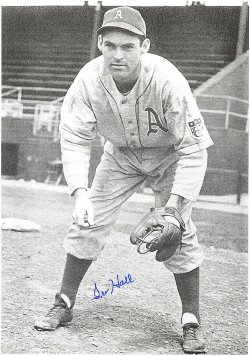 By Frederick N. Rasmussen
Irvin G. Hall (Age 88) Longtime Hillendale resident was an infielder with the Philadelphia Athletics.
During World War II Irvin Gladstone Hall, an infielder with the old Philadelphia Athletics during World War II who played in one of the American League’s longest games - a 24-inning tie in 1945 with Detroit - died in his sleep Tuesday at Stella Maris Hospice in Timonium. The longtime Hillendale resident was 88. Mr. Hall was born in Alberton, a small town on the Patapsco River that was renamed Daniels, and raised in Hampden. He was a 1936 graduate of Polytechnic Institute.
“He didn’t play baseball in high school, but played a lot of sandlot baseball around Baltimore and then tried out for the Eastern Shore League,” said a son, Mark A. Hall of Catonsville. Though Mr. Hall wasn’t considered good enough to make the baseball team at Poly, he went on to play six years in the minors and four in the American League - all with the Philadelphia team that later became the Kansas City A’s and then the Oakland A’s. In 1937, he launched his professional career with Pocomoke City in the old Shore league and played there until being signed by a team in Syracuse, N.Y., in 1939. Mr. Hall was a shortstop with Williamsport in the Eastern League when he was signed in 1943 by the Athletics, then managed by the legendary Connie Mack. “Playing baseball for Connie Mack was a great thing,” Mr. Hall said in an interview for Along the Elephant Trail, a publication of the Philadelphia Athletics Historical Society.
“If you made a bad play, or didn’t think something through, instead of screaming at you like most managers, he would call you over and quietly discuss the play,” he said. “If you couldn’t play for Connie Mack, you couldn’t play baseball.” Mr. Hall’s career was almost cut short by the draft. Ordered to report for induction into the Army at 6 a.m. July 21, 1945, in Philadelphia, he bade farewell to players and coaches and celebrated his last evening of civilian life with an expensive dinner, a nightclub floor show, and drinking beer with several players from the Cleveland Indians, the team the A’s had played earlier that day. Much to Mr. Hall’s surprise, draft board physicians gave him a 4-F rating - medically unfit for service. “I kept saying if I could play big-league baseball, I sure was able to carry a pack in the Army,” he told Sun sports columnist John Steadman in 1995. “But the doctors insisted they were giving the orders - not me.” Mr. Hall hailed a cab and sped to Shibe Park in North Philadelphia, where the A’s were facing the Detroit Tigers in a 3:15 p.m. game. With no sleep for 24 hours and no breakfast, Mr. Hall raced into the ballpark, stopping only long enough to grab a Coca-Cola and two hot dogs while heading for the locker room. By 3 p.m., he was in uniform and sitting in the dugout. “I believe Connie Mack, our manager, thought he was looking at a ghost,” Mr. Hall said in the 1995 article. “The day before he wished me luck and promised we’d see each other when the war was over.” Mr. Mack erased the replacement second baseman’s name from the lineup card and wrote in Mr. Hall’s, and Mr. Hall took the field in front of 4,526 fans for what was to become a marathon game - and the longest in the American League to end in a tie score. “I remember in an early inning of the long game, I was the pivot man on a double play and Dick Seibert, our first baseman, was almost begging me to get rid of the ball after I made the force at second,” Mr. Hall said in the newspaper interview. “I was so wiped out I just couldn’t get much on the throw, but I still got it there in time to get the second out.” After 24 innings that had lasted 4 hours and 48 minutes, with the score tied at 1-1, umpire Bill Summers called the game because of darkness. “It was getting increasingly difficult to see the ball because of the shadows cast by the high stands of Shibe Park,” the umpire explained to The New York Times.
Impressed by Mr. Hall’s efforts in the game, Mr. Mack awarded him a $1,500 bonus check for “playing hard,” Mr. Hall said in the newspaper interview - a tidy sum considering that his salary for the year was $4,500. “He was a very modest man and didn’t like talking about himself,” said another son, Richard M. Hall of Towson. “He did like to tell stories about Ted Williams, Joe DiMaggio, George Kelly and Joe Gordon.” Mr. Hall’s playing career ended in 1946, with a batting average of .261 through appearances in 508 games - most of them at second base and shortstop, according to the reference book Total Baseball. He subsequently coached the Aberdeen Pheasants in North Dakota for four years - a Northern League team affiliated with the St. Louis Browns. From 1952 to 1967, Mr. Hall worked in the engineering department of the old Glenn L. Martin Co. in Middle River on the Mace missile project and also coached the Martin Bombers baseball team.
In 1968, he joined the Baltimore County Bureau of Engineering and worked as a mechanical engineer until retiring in 1987. In 1974, Mr. Hall realized a lifelong and much-delayed dream when he earned his bachelor’s degree in mechanical engineering from the Johns Hopkins University. His college studies, started in 1946, were delayed by his baseball career and later by family responsibilities. Mr. Hall lived on Deanwood Road for 50 years until moving to the Brighton Gardens nursing home two years ago. He never lost his love for baseball and had attended every Orioles Opening Day game from 1954 to last year. “He didn’t get to it this year for logistical reasons but did get to the season’s second game,” Mark Hall said. Mr. Hall had been an avid golfer and shot a 70 at Clifton Park when he was 72. He continued to enjoy the sport until 2004. His wife of 43 years, the former Mary Rose Davis, died in 1998. A Mass of Christian burial will be offered at 9:30 a.m. today at St. Thomas More Roman Catholic Church, 6806 McClean Blvd. Also surviving are three daughters, Susan M. Zerofsky of Towson, Linda M. Fragoso of Gaithersburg and Danielle Jahnigen of Melbourne, Fla.; a sister, Doris Taylor of Dundalk; and nine grandchildren. An earlier marriage to Margaret Wilson ended in divorce.
rasmussen@baltsun.com
Sun researcher Paul McCardell assisted with this
article.
IRV HALL PASSES AWAY
by Max Silberman
One of the most regular reunion guests was A’s infielder Irv Hall who played all four infield positions between 1943 and 1946. Most of his time was spent at 2nd base and shortstop.
At the October reunion of 2006, Irv appeared as usual accompanied by his son-in-law. Despite not being in the best of health, Irv was as friendly and dignified as always
On December 12, 2006, Irv Hall departed this life after facing some physical challenges. The fact that he appeared at the reunion spoke volumes as to the quality and dedication of this wonderful gentleman.
As a player, he began in his home state of Maryland in 1937, reaching the majors in 1943. He continued with the A’s until 1946 and played in the minors until 1951 when he became a manager in the St. Louis Browns minor league system.
He was a productive hitter but was known for his outstanding fielding. He drove in the only run in Dick Fowler’s no hitter. Irv always modestly stated that he was unaware of his feat until after the game.
Irv Hall attended almost every function of the A’s Society. Several years ago, a bus trip was taken to Baltimore and Irv showed up to host us in his home town.
His passing leaves 69 surviving players. He was 88 years old and we pray that he is granted a perfect rest.. He was the son in Law Norman Zerosky.
Everyone with whom he came in contact loved and respected him.