IRA THOMAS: CONNIE MACK’S LIEUTENANT
 by Dale B. Smith
“It was the best of times, it was the worst of times”. Charles Dickens could easily have been referring to the 1914 season of the Philadelphia Athletics. For Connie Mack, 1914 meant both another American League pennant and the destruction of his Athletics family. It was a year of bitter disappointment for Mr. Mack. It was a year in which many that he felt were part of his loyal family would seemingly turn their backs on him.
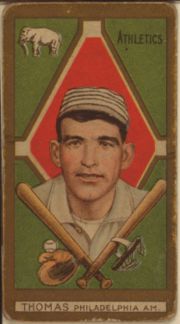
In this year, cloaked in suspicion and hard feelings, Connie Mack turned to the one person he felt would remain loyal to him until the end, one in whom he could have total trust. For his 1914 team captain he selected his former catcher and current coach, Ira Thomas. According to Thomas Macht in his book “Connie Mack and the Early Years of Baseball”, it was not a popular choice.
The naming of a team captain was usually reserved for a veteran player, an everyday player who was popular among his teammates, a natural leader and one who always seems to deliver in the clutch. Those qualifications seemed to describe star second baseman Eddie Collins, or, if not Collins, Harry Davis, a current coach and former star player. Both were fan favorites. So why did Connie Mack select Ira Thomas? For one thing, Connie Mack just plain liked the guy.
Ira Felix Thomas was born January 22, 1881 in Ballston Spa, New York. Starting his minor league career in the Connecticut League in 1902, Ira was catching on the second place New York Highlanders in 1906 as a 25 year old rookie. Sold to the Detroit Tigers for the 1908 season, Ira served the Tigers as a back-up catcher while the Tigers achieved their second straight pennant only to lose the World Series to the Chicago Cubs for the second straight year. Ira earned the distinction of delivering the first pinch hit in World Series competition.
In December of 1908, at the age of 27, Ira was sold to the Philadelphia Athletics. It marked the beginning of a lifelong friendship with A’s manager Connie Mack. With the opening of beautiful, new Shibe Park on April 12, 1909, Ira expected to be one of several back-up catchers to starting catcher Mike Powers. After opening day, however, Powers was taken to the hospital with an intestinal disorder where he died two weeks later. Ira Thomas was thrust into the position of first string catcher for the 1909 season, hitting .223 for the second place A’s.
In 1910 Ira split catching assignments with Jack Lapp while upping his average to .278. With the pennant winning Athletics going to the World Series, Connie Mack chose Ira as his primary catcher, starting four out of five games. In the World Champion Philadelphia Athletics four games to one victory over the Chicago Cubs, Ira got three hits in 12 at bats for an average of .250. Thomas saved his best season, however, for 1911 where, as starting catcher, he hit .273 with 81 base hits. In the American League MVP voting, Ira Thomas finished in 8th place. In the Philadelphia Athletics 1911 World Series victory over the New York Giants, Ira caught four out of six games.
Ira Thomas’ playing time was greatly diminished during the 1912 and 1913 season as Ira became more involved with 1st base coaching duties. Ira Thomas retired with 327 career base hits and a .242 batting average. Six additional hit came in 10 World Series games. Meanwhile, outfielder and team captain Danny Murphy, who had been with the A’s since 1902 and was a fan favorite, had seen his playing time greatly reduced. At 36 years old, Connie Mack no longer had a spot on his roster for the aging outfielder. What Norman Macht refers to as Connie Mack’s “brain trust” was know reduced to Harry Davis, second baseman Eddie Collins and Ira Thomas. With Danny Murphy signing with Brooklyn of the new Federal League, he immediately became its advocate. Murphy’s friends on the Athletics became well aware of the financial rewards for joining the Federal League. And Connie Mack was growing uneasy.
Eddie Collins would certainly seem to fit the bill for a new team captain. He was smart, a leader, popular with his teammates as well as the fans and delivered in the clutch. As such, however, he certainly would have been a prime target for offers from the Federal League.
Third base coach Harry Davis had been with the Philadelphia Athletics since the beginning in 1901. If Connie Mack feared losing Eddie Collins to the Federal League, there was no such risk with Davis. He was popular with the players and had seniority over Ira Thomas. So why did Connie Mack choose Ira Thomas?
According to Macht, Ira Thomas was what Mr. Mack probably saw as being a good role model for the younger players as he did not smoke or drink and appeared to stay away from players who enjoyed such things. While his preaching of abstinence may have made him popular with Mr. Macht, it did not necessarily endear him to his fellow players. In fact, a case could be made that appointing Thomas as team captain lead to dissention that would cause the 1914 second half swoon and would ultimately see them lose the World Series to the Boston Braves in a sweep.
Articles written following the 1914 season suggested that many players were not happy with Ira Thomas as team captain. Fellow coach Harry Davis indicated that he now had only limited communication with Mr. Mack, stating “I am only the third base coach. Thomas is his lieutenant”. On top of this, Ira Thomas was interviewed and was critical of Eddie Collins for giving away team secrets in Collins’ own articles.
Whatever internal squabbling had occurred, Connie Mack never listed that as the reason for his breakup of the Athletics following the 1914 season. In a series of sales and releases, Connie Mack’s 1910-1914 dynasty team was torn apart. Connie later put blame on the Federal League, distracted players, declining attendance and the national economy for the breakup. There do not appear to be any references to Connie Mack having any thoughts that Ira Thomas had a part in the downfall of the 1914 team.
To the contrary, Ira Thomas would continue in Mr. Mack’s favor for eternity. Ira continued as coach for Connie until 1917. After managing in the minor leagues, Ira returned as a scout for the Athletics in 1925. For the next 30 years, Ira would be the Athletics super scout, even following the A’s to Kansas City in 1955. Connie Mack would credit Ira Thomas with bringing him Lefty Grove and George Earnshaw among others.
More than that, Ira Thomas was Connie Mack’s friend, business partner and confidant. They would travel the banquet circuit together where Ira was known as an entertaining public speaker, often comparing baseball to life. Ira enjoyed telling tales about scouting Lefty Grove and Jimmie Foxx, often taking large liberties in creating bigger than life characterizations. His characterization of Connie Mack, however, was always sincere and heartfelt, referring to Mr. Mack as a father to the players rather than a manager and saying that the Athletics were a family.
Perhaps in Connie Mack’s mind, Ira Thomas’ manner, friendliness, morals, loyalty, knowledge of the game and knowledge of the A’s pitchers all seemed to add up to a team captain position before the 1914 season was underway. It was apparently not a popular decision among veteran players. Dissension would follow. It was a dissension that Connie Mack would take personally. While Connie would later invite several of his prodigal sons back into his A’s family, it was Ira Thomas that never left, was always loyal, was always there.
When Connie Mack died in 1956, Ira Thomas followed him on October 11, 1958 at the age of 77. The word “followed” is most appropriate. Old soldiers never die and Ira Thomas was one loyal lieutenant.