Inaugural Season: The 1883 Phillies
 By Bob Warrington
Introduction
2008 marks the 125th anniversary of the founding of the Philadelphia Phillies. Since that inaugural season, there have been a few great Phillies’ teams, some good ones, many mediocre ones, and too many awful ones. The fact that on July 15, 2007 the Phillies became the first franchise in any professional sport in North America to lose 10,000 games is indicative of the mostly unsuccessful seasons Phillies’ fans have had to endure in following the club down through the years.
The journey to the 10,000-defeat nadir had to start somewhere, and for the Phillies it was in 1883. Let’s look back on the origins of the franchise and find out how it all began.
The Origins of Major League Baseball
The story of the 1883 Phillies begins in 1876 with the formation of the National League. The new league emerged that year from the shambles of the National Association of Professional Base Ball Players, an organization which had existed from 1871-75 but was poorly administered, riddled with corruption, plagued by unstable franchises, and unable to stage worthwhile pennant races. William Hulbert, a stockholder in the Association’s Chicago White Stockings franchise, took the lead in forming a new organization for the 1876 season—the National League of Professional Base Ball Clubs—that would be organized and run in a manner intended to remedy the shortcomings that had bedeviled the Association.
One of the most visible shortfalls in the Association was the failure of teams to play full schedules. Once hopelessly out of a pennant race, clubs would simply stop playing all of their games, especially those that had little prospect of realizing a profit. In the 1875 season, for example, the Association’s Boston Red Stockings coasted to the title with a 71-8 record. The Red Stocking’s lopsided margin of victory led to nearly half of the other teams in the league failing to finish their full quota of games because those scheduled later in the season had become meaningless and people would not pay to see them.
In 1875, several teams in the Association refused to travel beyond their own region to play other members of the league, fearing that the costs of doing so would far exceed any profits they could hope to make in staging the contests. The Brooklyn Atlantics and New Haven Elm Citys, for example, only played other “eastern” clubs and failed to make western tours to play Chicago and St Louis. Likewise, the St. Louis Reds declined to journey to play “eastern” teams, feeling that to do so would cost the club more than it could possibly hope to recoup in revenues from the games. This situation led to Association teams not completing an equal number of games by season’s end, playing unbalanced schedules in terms of opponents’ faced, and undermining the credibility of the league as a competitive and honest organization.
The National Association expired after the 1875 season when Hulbert, backed unanimously by the “western” teams in the league, got agreement from the “eastern” clubs to form the new National League (NL). Several teams from the Association made the transition to the new alliance, including the Philadelphia Athletics, Chicago White Stockings, Boston Red Stockings, and New York Mutuals.
Hulbert prepared a constitution for the NL with several goals in mind; chief among these was to make the organization respectable and profitable. Of the many provisions that governed the new league, one was aimed at eliminating the gambling element that had so tarnished the Association. It decreed that any player found guilty of dishonesty would be barred for life from playing in the NL. In addition, to preclude financially wobbly franchises from entering the league, any city represented in it had to have a population of at least 75,000. Yet another provision mandated that all clubs must complete their schedules, regardless of the distance traveled to do so or their place in the standings.
Philadelphia in the National League…But Not For Long
The National League opened its 1876 inaugural season consisting of the following teams: Chicago White Stockings, Hartford Dark Blues, St. Louis Brown Stockings, Boston Red Stockings, Louisville Grays, New York Mutuals, Cincinnati Red Stockings, and Philadelphia Athletics. (The 1876 NL Athletics club should not be confused with the Philadelphia Athletics that played in the American Association between 1882-91, or the Philadelphia Athletics that played in the American League between 1901-54.) Morgan G. Bulkeley, president of the Hartford club, was elected the league’s first president.
Expectations that the NL’s stringent constitution would engender stability and conformity in league operations were dashed before season’s end when two “eastern” clubs that were hopelessly out of the pennant race announced they would not make their final “western” road trips to save money. The New York Mutuals and Philadelphia Athletics were confident that the NL needed them more than they needed the league. Moreover, clubs had done this with impunity during the National Association years, and many doubted the NL would take to task teams representing the two largest cities in the circuit. But the owners of the Mutuals—W. H. Cammeyer—and the Athletics—G. W.
Thompson—guessed wrong in their estimates. At a meeting of league owners in Cleveland on December 7, 1876, New York and Philadelphia were expelled from the NL for having failed to honor their schedule commitments. Both cities would not be represented in baseball at the major league level for five years (1877-81).
A League is Born and a President Dies
In addition to expelling the Mutuals and Athletics from the NL, owners replaced Bulkeley as league president with William Hulbert. Bulkeley had taken the job reluctantly, given his responsibilities as a Hartford insurance and banking executive, and served largely as a figurehead. Hulbert’s elevation to the top spot made sense since it was clear following the league’s first season that he was the power behind the throne and would be the iron-willed and fully committed president needed to navigate the NL through the rocky shoals of its formative years.
Hopes that the NL would possess more stability over time in its roster of clubs compared to the National Association’s constantly shifting membership proved overly optimistic. The first decade of the NL was marked by franchises being added and dropped on a regular basis. By its third year of operations (1878), the league had shrunk from eight to six clubs, and just three of its original eight members—Boston, Chicago, and Cincinnati—were still in place. Franchises were eliminated for a number of reasons. Some were expelled for league rules violations; others could not maintain the financial wherewithal to remain in the league. Still others dropped out voluntarily, believing it was more profitable to play as independent clubs rather than as part of an organized league. By 1882, the NL had expanded back to eight clubs that were concentrated along the New England coast and Great Lakes to save transportation costs. Boston, Providence, Worcester, and Troy held the “eastern” franchises, while Chicago, Cleveland, Detroit, and Buffalo made up the “western” ring.
The NL’s unique position as the only baseball alliance to claim major league status, which it enjoyed for six years (1876-81), came to an end in 1882. Six cities, which for a variety of reasons were unrepresented in the NL, joined together to form the American Association (AA) and proclaimed it a second major league organization. The men who met in Pittsburgh in October 1881 to create the AA knew that the key to their success in ending the NL’s monopoly on major league baseball was in establishing franchises in Philadelphia and New York. Representatives from independent clubs in both cities—John Day of the New York Metropolitans and Chick Fulmer of the Philadelphia Athletics—were present at the meeting and agreed to join the AA. The other members of the new league were the Cincinnati Red Stockings, Louisville Eclipse, Pittsburgh Alleghenys, St. Louis Browns, and the Baltimore Orioles.
Philadelphia, New York, St. Louis, Cincinnati, and Louisville had all dropped out or been expelled from the NL, and owners of those teams in the AA were especially eager to challenge the elder circuit’s monopoly on major league status. The AA adopted rules to distance itself from the NL—playing Sunday games, employing full-time salaried umpires, allowing clubs to set their own minimum and maximum admission prices, etc.—and began operations in 1882.
NL magnates recognized the seriousness of the challenge posed by the AA, and the vulnerability of their position in allowing the upstart league to have the only clubs resident in major cities like Philadelphia, New York, and St. Louis. NL President Hulbert, to enforce clubs’ adherence to league rules, was adamant that cities expelled from the league would not be readmitted to it. Fate intervened on April 10, 1882, however, when Hulbert died of heart failure. The presidential vacancy created by his death was filled by the election to the post of A. G. Mills—a lawyer, Civil War veteran, and former official of the Olympic baseball club of Washington, DC. Mills brought to the position a more forgiving attitude toward readmitting cities to the NL’s roster, especially those in which a rival Major League had already taken up residence.
Relocating NL Franchises
Mills’ understanding that the NL would be seriously disadvantaged without representation in large cities, combined with his eagerness to jettison weaker franchises, prompted him to move quickly in making changes to the league’s structure. His gaze turned toward two NL clubs that had struggled badly in terms of fielding competitive teams, drawing patrons to games, and realizing a profit in their operations: the Worcester Brown Stockings and Troy Haymakers.
Worcester had joined the NL in 1880, replacing the Syracuse Stars, which had lasted just one year in the league. Not everyone wanted Worcester in the NL. The Troy Haymakers-which had joined the league in 1879-preferred the admission of nearby Albany, but these two cities were too close together for the taste of then-president William Hulbert. When Worcester applied for admission to the NL in the fall of 1879, however, it had a population of 58,291, not enough to meet the league minimum standard of 75,000. Hulbert allowed the Massachusetts city to count its suburban residents, pushing Greater Worcester over the population minimum for league admittance.
On May 1, 1880, Worcester started play in the majors, drawing 1,000 people to the old Fair Grounds in Agricultural Park, across Agricultural Street from Elm Street. (The area is now a residential neighborhood.) Worcester’s nine beat the Troy club 13-1.
Worcester finished a respectable fifth in 1880 with a 40-43 record, but then dropped into the cellar for the next two seasons with records of 32-50 and 18-66, respectively. In addition to fielding miserable teams, Worcester simply didn’t draw enough fans to home games to make the franchise profitable for either its owners or the NL. The club’s last game at home was played on September 29, 1882 before a crowd of only 18 spectators. Worcester lost to Troy 10-7.
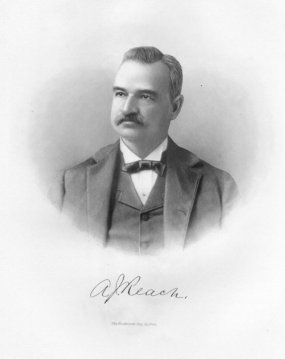
Anxious to implement structural changes before the start of the 1883 season, Mills met with a group of Philadelphians interested in obtaining a club for the city. Mills had already announced the transfer of the Troy franchise to New York to become the New York Mutuals. Mills told the assembled investors, “We’ve moved Troy to New York, and now we’re going to shift the Worcester franchise. They’re not big enough up there to support National League ball. I’d like to see that club in Philadelphia.” Toward that end, Mills called on his old friend, Alfred J. Reach, to see if the former ballplayer and successful entrepreneur would be interested in owning the club relocating from Worcester.
Enter the Philadelphia Phillies
Al Reach had a distinguished career in baseball well before he was approached by Mills in 1883. Reach had been a star second baseman for the Brooklyn Eckfords team in the immediate post-Civil War era. He also was the second baseman for the Philadelphia Athletics when that club won the first National Association title in 1871 behind Reach’s .353 hitting.
With his years as a baseball player drawing to a close in the mid-1870s, Reach relied upon his entrepreneurial skills for a second career as a businessman. Recognizing the expanding market for baseball and other athletic equipment, he opened a sporting goods store in Philadelphia in 1874. His business thrived, and in 1881 he moved to a larger store in downtown Philadelphia and opened a baseball manufacturing plant in North Philadelphia. Reach’s baseball background and the wealth he had accumulated from his successful sporting goods manufacturing business are what drew Mills to him to inquire about owning Philadelphia’s new entry in the NL.
“You get the backing, build a ball park, and I’ll move the Worcester franchise into Philadelphia,” Mills told Reach, according to Frederick Lieb and Stan Baumgartner in their book “The Philadelphia Phillies.” Reach responded, “I’m in.” His partner in owning the new club was Colonel John I. Rogers. Together, these two men would oversee and operate the NL’s Philadelphia team from 1883 through the 1902 season.
Reach selected the team’s new nickname, “Phillies,” making it one of the most easily understood monikers in professional sports. A “Phillie” is a player from Philadelphia. As Al Reach himself said of the nickname, “It tells you who we are and where we’re from.” (Quoted in Donald Honig, “The Philadelphia Phillies: An Illustrated History.”)
The club leased an irregularly shaped parcel of land in the city’s northeastern section that was bound by Twenty-fourth Street, Columbia Avenue, Twenty-fifth Street, and Ridge Avenue. Working against the rapidly approaching deadline of Opening Day—May 1, 1883—a team of carpenters constructed a modest wooden grandstand and bleachers that could hold approximately 8,000 spectators. Reach christened it “Recreation Park.”
The 1883 Phillies Squad
To manage the 1883 team, the Phillies tapped Bob Ferguson, who in 1882 had managed the Troy Haymakers team in the NL. The Troy club was moved to New York after the 1882 season, and it was given a new name and a new manager, thereby freeing up Ferguson for the Phillies’ job.
The greatest challenge Reach faced in fielding his new club was staffing it with capable players. As Lieb and Baumgartner write, “When Reach and Rogers took over the Worcester club, they got nothing but the franchise, as the defunct New England team’s worthwhile players had already been gobbled up by other clubs. It meant Reach and Rogers had to start from scratch in building up the club.”
By obtaining only the rights to operate the relocated club, none of the players who were on the Worcester Brown Stockings in 1882 played for the Phillies in 1883, although two of them—slugger Harry Stovey and pitcher Fred Corey—came to town to play for the Philadelphia Athletics of the rival American Association. (It may have been a blessing in disguise for the Phillies not to pick up most of the players from Worcester’s 1882 roster. That team, as noted, finished the season in last place with a record of 18-66, a full 37 games out of first place.)
The need to scramble to fill the roster led to a patchwork quilt of players to staff the Phillies’ squad, as is accurately captured by Rich Westcott in his book, “The Phillies Encyclopedia:”
“Having built a team from scratch after obtaining the Worcester, Massachusetts franchise, owners Al Reach and John Rogers had to put together a club made up mostly of ex-minor leaguers and players they were able to coax away from other National League teams. The first Phillies squad, therefore, was an odd and somewhat disorganized collection of players.”
The need to compete using minor leaguers, players from semi-pro leagues, and whatever major leaguers that could be obtained made playing for the 1883 Phillies a fleeting experience for many individuals. The 1883 roster was characterized by continual player turnover as personnel were given a look and then dismissed when found wanting to make room for others to prove they were major league-caliber players.
Twenty-nine players appeared on the field for the Phillies in 1883. While a low number by contemporary standards, that many players on a roster was an extraordinarily large figure in the 19th century. The Boston Red Stockings, who won the 1883 NL pennant, used a mere 12 players during the year. Even the New York Mutuals, who like the Phillies were just starting out in the league in 1883, used only 16. (To compare these figures with the much larger number of personnel who now play for a team during a season, the 1996 Phillies had 56 players appear on their roster—tying a NL record.)
Only 10 of the 29 individuals appearing for the Phillies in 1883 had previous major league experience, which means that almost two-thirds of the players were rookies when they took the field that year. Five of the 29 players, moreover, never again played in the major leagues after appearing for the Phillies.
With so many players of suspect ability performing for the team in 1883, club officials were unforgiving in terms of quickly dismissing those who didn’t measure up. Fifteen of the Phillies’ players appeared in five or less games. Of those 15, seven appeared in just one game for the team. For over half (15 of 29) of the Phillies’ players to have participated in no more than five games is indicative of the Draconian measures the club employed in 1883 to exile personnel who did not measure up to major league standards.
The weeding out process, however, was far from successful in terms of discovering many players who could be retained once the 1883 season had ended. Twenty-one of the 29 players who played for the club in 1883 were not on its roster in 1884—a turnover of almost 75 percent in personnel between the two years.
All who have watched Kevin Costner’s 1989 film, “Field of Dreams,” can recall the saga of Archibald “Moonlight” Graham as it was portrayed in the movie. Graham made his debut in the major leagues in 1905, playing briefly in one game for the New York Giants. He never again appeared in a major league game.
Of the seven players who appeared in just one game for the Phillies in 1883, two never again played in the Major Leagues. Although it is highly unlikely their tales will ever be told on the Silver Screen, both deserve mention in this story as men who appeared for the Phillies during the club’s inaugural season.
Alonzo Breitenstein pitched in one game for the Phillies, beginning and ending his major league career on July 7, 1883. He was the starting pitcher, lasted five innings, and gave up eight hits and two walks. Breitenstein racked up an unenviable ERA of 9.00 and lost the game. He was 24 years old when he took the mound and lived until he was 74 years old. Breitenstein walked off the field and into Phillies history on that July day in 1883.
C. B. White played shortstop in one game for the Phillies, starting and ending his major league career on June 1, 1883. He appeared briefly for the team that day as a substitute shortstop and batted just once during the game. He made an out. White was born in Wakeman, Ohio, but his birth and death dates and where he died are unknown. Moreover, only the initials of his first and middle names are recorded. Nonetheless, when C. B. White took the field for the Phillies on that June day in 1883, he made an entry in the team’s recorded history as one who played during its inaugural season. He deserves some recognition for that.
A Dreadful Season
Given the turmoil that characterized the Phillies’ roster in 1883 and the need to rely on so many players without major league-caliber skills, it’s not surprising that the club was abominable. As one baseball historian notes, “The club quickly revealed its flimsy foundation and began compiling the worst record ever for a franchise that was to suffer through many more nightmarish seasons.”
The club played its first game in the NL at Recreation Park on May 1, 1883 and was bested by the visiting Providence Grays 4-3. Attendance at the game was 1,200, and it took 90 minutes to play. Things continued to go south for the Phillies as the season unfolded. By season’s end, the club had compiled a record of 17-81, a woeful winning percentage of .173, and a full 46 games out of first place. The Phillies actually won only 16 games on the field. The 17th victory came on a forfeit by Providence on July 4th.
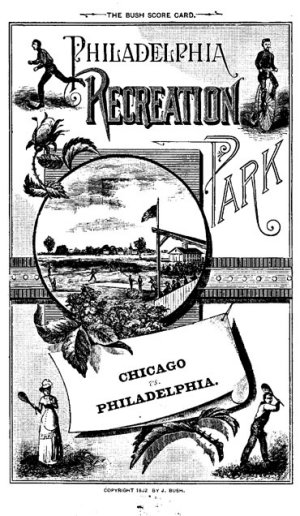
Some of the team’s losses were by memorable scores. The Phillies lost one game to Boston by 29-4 and another to Providence by 28-0. An image of the front cover of a Phillies’ scorecard from 1883 accompanies this article. It shows an artist’s depiction of Recreation Park, and that the Chicago White Sox were the opponents in the game for which this card was printed. The person who attended the game recorded it on the scorecard, and the results show that the Phillies were soundly beaten by the White Sox on this particular day by a 22-4 score.
Such an awful season led to some abysmal statistics for individual players on the Phillies. At the top of the list is pitcher John Coleman. On the plus side, Coleman won 70 percent of the Phillies’ games by being the winning pitcher in 12 of the team’s 17 victories. (Steve Carlton, by comparison, won 46 percent of the Phillies’ games in 1972 by notching 27 victories for a team that could manage only 59 tallies in the win column.)
On the other hand, Coleman lost 48 games in 1883, still a NL record 125 years later. The team’s number two pitcher, Art Hagen, went 1-14 for the club. Phillies’ pitchers, not surprisingly, did not get much offensive support. The team’s batting average of .240 was the lowest in the league in 1883.
In playing through such an awful season, the Phillies’ won-lost ratio for home games versus away games was remarkably similar. The team went 9-40 at home and 8-41 on the road.
Bob Ferguson lasted only briefly as the Phillies’ skipper. He relinquished the position after his team had gone 4-13 to start the season, and was content after that to be the club’s regular second baseman and work part-time in the business office. Blondie Purcell, the Phillies’ leftfielder, managed the team through the rest of the season, achieving an unenviable record of 13-68.
While the Phillies were struggling through all of this misery, the rival Philadelphia Athletics were winning the American Association title with a 66-32 record—the only pennant the Athletics would win as part of the Association. By midsummer, the Phillies were so deep in the cellar that NL magnates reluctantly gave the club permission to reduce its base ticket price from fifty cents—the official league minimum—to a quarter to draw fans away from the Athletics.
No Where To Go But Up
With such an inauspicious beginning, more than a few of the residents of the Quaker City wondered if the Phillies would even be back after the 1883 season. Friends urged Al Reach to throw in the towel and not spend good money after bad. The Phillies’ president, however, was far from discouraged. Lieb and Baumgartner quote him as saying after the 1883 season, “We spent a year finding ourselves. Of course, it was expensive; we made mistakes, but we learned from our experiences. Philadelphia has the population and interest to support a second club, and some day the Philadelphia National League club will be famous—more famous than the Athletics.” (Reach’s words were more prophetic than he realized. Not only would the Phillies outlast the Philadelphia Athletics of the American Association, they would eventually eclipse the Philadelphia Athletics of the American League.)
Al Reach moved immediately to begin strengthening the Phillies. Wisely, he hired Harry Wright—one of baseball’s greatest managers and an eventual Hall of Famer—to pilot the club in 1884. Wright had a long and distinguished career in baseball as a player and manager, and engaging this capable individual to skipper the team was the first foundational step in the Phillies’ ascent from rock bottom.
At the top of the list of player acquisitions that would help transform the Phillies into a competitive club was pitcher Charley Ferguson. He won 21 games for the Phillies in 1884, more victories than the entire pitching staff had achieved in 1883. He would win 26, 30, and 22 games, respectively, over the subsequent three years.
Improvement in the Phillies’ fortunes came immediately. The club climbed from eighth to sixth place in 1884. By 1887, the team was contending for the pennant. Improvement also was sustained. The team didn’t finish in last place again until 1904.
Despite the disaster that was 1883, the die for the Phillies had been cast. From that humble beginning one of the pillars of the National League emerged that thrives to this day and that has become indelibly associated—for good and bad—with Philadelphia and its fans.
THIS IS A GREAT ARTICLE!! I HAVE BEEN A PHILLIES FAN FOR 55 YEARS AND I TRULY LOVE THE PHILLIES. IT IS TRUE THAT I HAVE SUFFERED BUT THERE HAVE BEEN MANY GREAT MOMENTS. THE 2008 WORLD CHAMPIONSHIP WAS MEMORABLE BUT WHEN MY PHILLIES WON THEIR FIRST WORLD CHAMPIONSHIP ON TUESDAY, OCTOBBER 21,1980 AT 11:29 P.M.IT MADE MY HEART GLOW! I SHALL ALWAYS LOVE MY PHILADELPHIA PHILLIES!!!!!!!