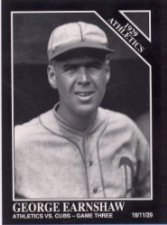
GEORGE EARNSHAW - THE RIGHT HALF OF MOSE AND MOOSE
 by Dale B. Smith
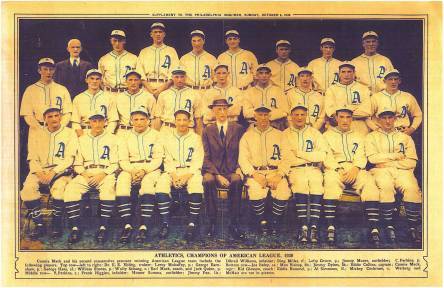
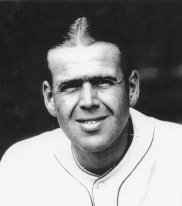
George Livingston Earnshaw and Robert Moses Grove were to share a similar destiny. They almost shared birth dates. George was born February 15, 1900 in New York City. Robert was born three weeks later on March 6th in Maryland. George grew to be 6’4” and 210 pounds. Robert grew to 6’3”. George’s nickname was “Moose”. Robert was known as “Lefty” and “Mose”. Both pitched Connie Mack’s Athletics into the World Series of 1929, 1930 and 1931. Both were aggressive, both threw hard, both threw strikes.
Robert, however, was a left handed pitcher. “Lefty” won 300 games, countless ERA and strikeout titles and in 1947, after a 17 year major league career, was elected to the Hall of Fame. “Moose” threw right handed. His career covered nine years with a total of 127 victories. But while his pitching career was short, there was perhaps no pitcher in the history of baseball whose brief time in the majors was as sweet.
Over 50% of George Earnshaw’s victories occurred during the A’s pennant winning years of 1929-31. He averaged 22 victories a year in that time period. He won a total of four World Series games, started eight games with five being complete games. He struck out 56 batters in 62 innings pitched and had an ERA for the three Series of 1.58. Connie Mack gave more credit to George Earnshaw for the Athletic’s 1930 World Series victory over the St. Louis Cardinals than any other player. If baseball had started a separate World Series Hall of Fame, George Earnshaw would have been a charter member.
George did not reach the majors until he was 28 years old. A graduate of Swarthmore College in Pennsylvania, he was a pitching star for the minor league Baltimore Orioles when Connie Mack purchased his contract in June of 1928. That season the A’s finished second, 2 ½ games behind the Yankees. Moose had a record of 7-7 with a 3.85 ERA and 117 strikeouts in 158 innings pitched.
It was in 1929 that George Earnshaw and Lefty Grove began to dominate big league pitching. For the next three years they were the only two pitchers on any one team to win twenty or more games.
The 1929 season was George’s turn to star. His 24 victories against 8 losses was the most in baseball and his 149 strikeouts was 2nd only to teammate Mose in the American League and 3rd in the majors. His fastball being wild at times, George’s 125 walks was an American League high but his 3.28 ERA was among the best in baseball.
The 1929 World Series against the Chicago Cubs saw Earnshaw and Grove combine to win Game 2, 9-3. George pitched a complete Game 3 only two days later but lost 3-1on a six hitter.
George struck out 17 batters in 13 innings with a 1-1 record as the A’s won the World Series 4 games to 1.
The 1930 season saw George’s strikeouts climb to 193, 2nd in baseball only to Lefty at 209. He finished at 22- 13 with Mose climbing to 28-5. He also led the majors in walks with 139.
It was George’s World Series performance in 1930 that was to be his career highlight, after only three years in the majors. With both the Athletic and Cardinal batters being contained (except for Simmons and Foxx), pitching dominated and no one dominated like George Earnshaw.
Moose won Game 2, pitching a complete game and allowing the Cardinals one run on six hits. In Game 5 at St. Louis, with the Series tied at two games each, George pitched a two hit shutout into the eighth inning. With the score tied 0-0, however, Connie pinch hit for Moose. With Grove in relief for the 8th and 9th innings, Lefty was the victor by way of a Jimmie Foxx, two run home run in the top of the ninth.
George was back on the mound starting Game 6 only two days later in Philadelphia. Pitching another complete game, he held the Cardinals to one run on five hits in a 7-1 victory which won the World Series for the Athletics. Moose had pitched 25 innings and had an ERA of 0.72 with 19 strikeouts.
1931 saw George finish with a 21-7 record and his 152 strikeouts was again 2nd to Lefty and 4th overall. His control was never better as his number of walks dipped to 75 and his ERA was 3.67.
The 1931 World Series rematch with the Cardinals saw George pitching in hard luck as he lost Game 2, 2-0 on a complete game, 6 hitter. The A’s had managed only three hits off Wild Bill Hallahan. Pepper Martin had scored both runs. In Game 4, Moose pitched a two hitter (both by Martin) in a 3-0 victory.
During the Series, George delivered one of the most memorable lines in baseball history as Connie Mack innocently asked him what Pepper Martin was hitting and George replied “Everything I throw up to him”.
With the Series tied 3-3 and George Earnshaw pitching, only 20,000 pessimistic Cardinal fans showed up for the final game in St. Louis. Moose again was masterful, allowing only five hits in eight innings, at one point retiring 15 batters in a row. But with a combination of bloop hits, a dropped third strike, a wild pitch and a George Watkins home run, the Cardinals won the game 4-2 and the Series as well.
In 1932, George was 19-13 but his ERA rose to 4.78 as the A’s finished second. The 33 year old lost his fastball in 1933 and fell to 5-10.
Traded to the Chicago after the season, George improved to 14-11 with the last place White Sox whose team now included old friends Jimmy Dykes, Mule Haas and Al Simmons. By 1936, George Earnshaw’s career came to a finish, ironically, playing with the St. Louis Cardinals and old nemesis Pepper Martin. Within a few years, George would find himself a Commander in the Navy in the World War.
On December 1, 1976, George Earnshaw died in Little Rock, Arkansas, a little over a year after Lefty Grove had died in Ohio in 1975. Together, their left/right combination had been one of the best in baseball history and individually, George’s performance in the 1930 World Series was one of the best ever. That was quite an accomplishment in a short, but sweet, career.