Ferris Fain: One Of A Kind
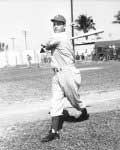 by David M. Jordan
Ferris Fain was truly one of a kind. The first baseman, who died on October 18 in Georgetown, California, marched to the beat of his own drummer, seldom caring what teammates, managers, or fans thought about him.
Yet among Philadelphia A’s fans, he was always a favorite for his hustling accomplishments on the field.
Born in San Antonio, Texas, on May 29, 1921, the son of former jockey Oscar Fain, Ferris Roy Fain grew up in relative poverty in Oakland, California. Baseball, however, presented a way out. At the age of seventeen, he signed with San Francisco in the Pacific Coast League, appearing in twelve games for the 1939 Seals. For the next three years, he was the team’s regular first sacker, batting .310 in 1941. In each of those three seasons, Fain led the league’s first basemen in errors, a trait which he would carry on to the big leagues.
Fain spent the 1943, 1944, and 1945 seasons in the military service, but he came back strong with a big year for the Seals in 1946, hitting .301 for Lefty O’Doul’s club and leading the Pacific Coast League with 112 RBIs. His performance caught the eye of Connie Mack, who was looking for a replacement for the disappointing George McQuinn, and the Athletics plucked Fain from San Francisco in the minor league draft for the bargain price of $7500.
Ferris was a revelation for the 1947 A’s and their fans. They soon realized why he made more errors than any other first baseman. Ferris Fain was the most aggressive first sacker anyone had ever seen. In a possible bunt situation, he charged in almost on top of the batter, in effect challenging the batter to try to hit it past him and messing up the timing of the bunt. Fain was equally daring in throwing to bases when he picked up the ball. Though his style obviously led to errors, and he led American League first basemen in that category every year but one that he played for the A’s, he also regularly led the league in assists as well, most of them signifying a lead runner cut down by Fain’s throw. Joe Gordon, the great second baseman, called Ferris simply “the best defensive first baseman ever.”
Ferris Fain was lefthanded all the way, five feet eleven inches tall and weighing in at about 185 pounds, called “Burrhead” for his hairstyle. He was not a home run hitter but possessed slashing power, always piling up a large number of doubles. He averaged between .263 and .291 in his first four seasons with the Mackmen and in 1950 was named to his first All-Star team, an honor which would come his way again each of the next three years. In 1949, Fain at first base was on the closing end of 194 of the total 217 doubleplays the A’s pulled off, still the major league record.
With all of his stellar work on the field, Fain presented some difficulties to management and his teammates. Possessed of a short fuse to his temper, Ferris was frequently involved in fights. In addition, he was a heavy drinker, which created further problems. Shortstop Eddie Joost said, years later, “He had a lifestyle of his own and would do exactly what he wanted to do. There were many things the players didn’t like about him.” Still, Gus Zernial, another teammate, said, “I don’t think his drinking hurt us.”
On the field, in 1951, Fain had his best season ever. Hitting .344, he won the American League batting championship, despite missing several weeks with a broken bone in his foot after kicking the bag in frustration at making an out. He repeated in 1952, winning his second title with .327, leading the league also in doubles and on-base percentage.
During the off-season, though, Fain was surprised to be traded, on January 27, 1953, to the White Sox with a minor league infielder for first baseman Eddie Robinson, infielder Joe DeMaestri, and outfielder Ed McGhee. The A’s wanted more power at first base, and Robinson drove in 102 runs for them. Fain, in Chicago, slumped to .256 and, after one more year with the Pale Hose and another year split between Cleveland and Detroit, was out of the league at the age of 34. His career average for nine big league seasons was .290, with 48 home runs and 570 runs batted in.
Ferris Fain went back to California, to live out the rest of his life in relative obscurity as a building contractor, making new headlines only with an arrest in 1986 for growing a small quantity of marijuana in his backyard. He visited the Philadelphia Athletics Historical Society once, attending our second reunion in Bensalem in 1997. He was a welcome guest, delighting his hosts with pungent comments on many subjects despite his obvious physical frailties. Talking about today’s players, Fain contended that “most of them belong in the bushes.” He knew that he could hit better than many of them, if he could just “convince the commissioner to let me get my wheelchair on the field.” Suffering from a variety of maladies over his last few years, Ferris is survived by his wife Norma and two children.
Always his own man, Fain let people know where he stood. Ever ready to oblige fans with his autograph, always welcome in any A’s gathering, Ferris Fain will be missed.
For more on Ferris Fain, click here to read an article from the San Francisco Chronicle.