Eddie Murphy’s Glass Bat
 By Bob Warrington
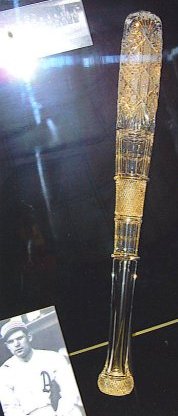
In the Corning Glass Museum in Corning, New York, there is on display a baseball bat made out of glass. The narrative card that accompanies the bat reads, “This bat was presented to John Edward Murphy of the Philadelphia Athletics, winners of the 1913 World Series.” Before we tell the story of the glass bat, let’s first take a look at the career of the man for whom it was made—Eddie Murphy.
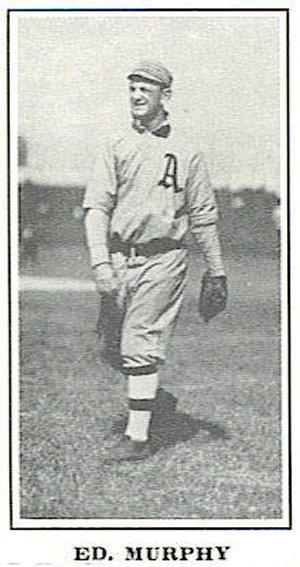
Eddie Murphy was born in Hancock, New York in 1891. He migrated to Pennsylvania to play minor league baseball and to attend Villanova University. Murphy played on several teams in the White Mills, Pennsylvania area and in 1907-08 was a member of the Honesdale, Pennsylvania town team, which was managed by John Christian Dorflinger. Murphy was playing for the Baltimore Orioles of the International League in 1912 when the Philadelphia Athletics purchased his contract. He joined the A’s late in the season, making his major league debut on August 26th and appearing in 33 games before season’s end.
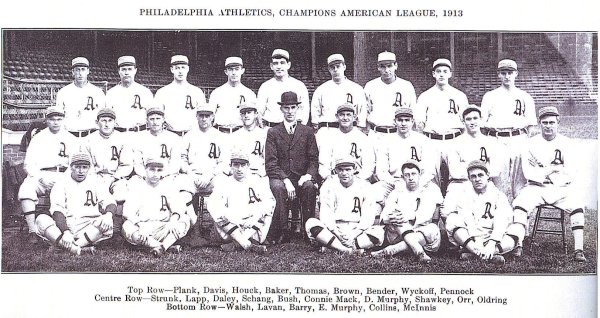
Connie Mack’s decision to bring the fleet-footed Eddie Murphy on board the Athletics as an outfielder was prompted when veteran player Danny Murphy began to slow down. Mack simply replaced the elder Murphy in right field with a younger player with the same surname. Eddie Murphy and Jimmy Walsh were two new outfielders on the Athletics’ team in 1913, flanking veteran Rube Oldring in centerfield.
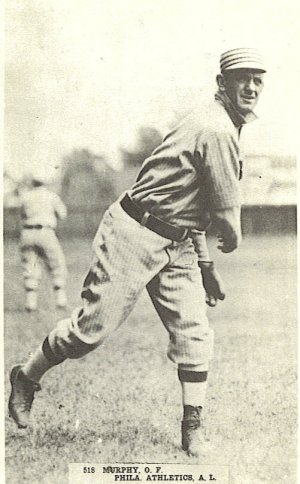
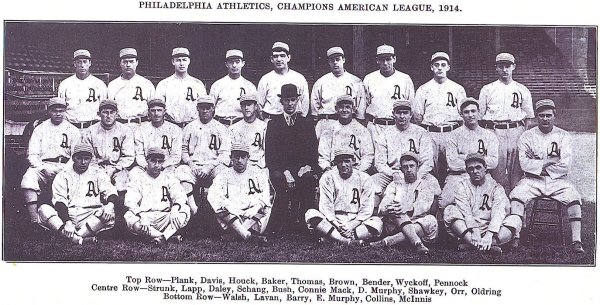
Eddie Murphy proved an able replacement. He batted a respectable .295, scored 105 runs, and stole 21 bases. Murphy was a key contributor as the Athletics’ took the American League (AL) title and bested John McGraw’s New York Giants four-games-to-one in the World Series. Indeed, he made the Series’ final putout.
Murphy again was the A’s regular rightfielder in 1914, and although his batting average dipped to .272, he still scored over 100 runs and stole 36 bases. The glory of that year ended with the AL pennant, however, as the Athletics were swept by the Boston Braves in the World Series.
Following the 1914 World Series, Mack dismantled his First Dynasty. Some players (Chief Bender, Eddie Plank, and Jack Coombs) were released outright so they could play elsewhere in 1915. Eddie Collins was sold to the Chicago White Sox. As the disastrous 1915 season unfolded for the Athletics and their losses mounted, more players were sold to enrich the club’s coffers. Herb Pennock and Jack Barry were sold to the Boston Red Sox; Bob Shawkey went to the New York Yankees. Finally, on July 15, 1915, Eddie Murphy was sold to the White Sox for $13,500. The A’s were in Chicago playing the White Sox, and the sale was consummated during a doubleheader between the teams. Murphy simply changed locker rooms between games of the doubleheader.
Eddie Murphy played for Chicago from 1915-21. He finished out his major league career in 1926 in 16 games for the Pittsburgh Pirates.
Now, let’s return to the glass bat.
John Christian Dorflinger, the manager of Eddie Murphy’s White Mills team back in 1907-08, worked at C. Dorflinger & Sons Glass Manufacturing Company in White Mills, PA. John’s father, Louis J. Dorflinger, was president of the company. When Eddie Murphy made good by being on the 1913 American League Champion Philadelphia Athletics, John and others at the Dorflinger plant wanted to honor the local diamond star who had made good in the big leagues. (It was not unusual in the early 20th century for native sons—even adopted ones—to be honored by their home towns when they achieved success in the major leagues. A player on a World Series championship team often received a parade, banquet, and award when he returned home.)
Since they worked at a glass plant, John Dorflinger and others had a cut glass bat of regulation size and shape made for Eddie Murphy. The bat was blown at Dorflinger’s White Mills glass plant by Peter Jones, and it was rough-cut by Fred Houth. The name of the craftsman who did the final cutting has not been preserved, according to records at the Corning Glass Museum.
Louis J. Dorflinger, who supported the presentation, was, nevertheless, mindful that the glass bat would cost money to create. In his diary, Louis made the following entry, “Baseball bat made for Eddie Murphy: cost to cut $13.60; glass $4.50; case $7.25; total cost $25.35.”
With the glass bat completed, John Dorflinger and Tom Gill—a bookkeeper for C. Dorflinger & Sons—took the train to Philadelphia on October 7, 1913, to present the bat to Eddie Murphy the next day. The Athletics were scheduled against the Giants in Philadelphia on October 8th to play the second game of the World Series. Originally, the bat was to be presented by Pennsylvania Governor John K. Tener, who was expected to attend the World Series game. Official duties, however, kept Tener in the state capitol that day, so Dorflinger and Gill decided to make the presentation to Murphy themselves.
Eddie Murphy received the glass bat from Dorflinger and Gill prior to the game played at Shibe Park. Dorflinger and Gill returned to White Mills the next day. The John Wanamaker & Company, located in Philadelphia, perhaps sensing an opportunity to attract customers, asked Murphy if it could put the bat on display in its department store at 13th & Market Streets. Murphy agreed, and the glass bat stayed on view at Wanamaker’s store for nearly a year. It was then returned to Murphy.
According to records at the Corning Glass Museum, the glass bat was loaned to the museum for exhibit by Mr. and Mrs. Edward Murphy. The next time you’re in the Corning, NY area and have the time, be sure to visit the Corning Glass Museum and take a look at Eddie Murphy’s glass bat.