Connie Mack Statute
 By Bob Warrington
When Connie Mack passed away on 8 February 1956, a groundswell of support rose to find a way to perpetuate his memory and establish a lasting tribute to the “Tall Tactician.” A Connie Mack Memorial Committee was created under the chairmanship of Philadelphia merchant and civic leader Arthur C. Kaufmann, and it decided to erect a statue in Mack’s honor. Fans were asked to contribute, and children sent in pennies and adults sent in dollars to raise the funds necessary to build a permanent tribute to the man who had done so much for baseball in a lifetime of service. The $20,000 for the statue was raised by the end of the year, and noted sculptor Harry Rosin was selected to create the artwork.
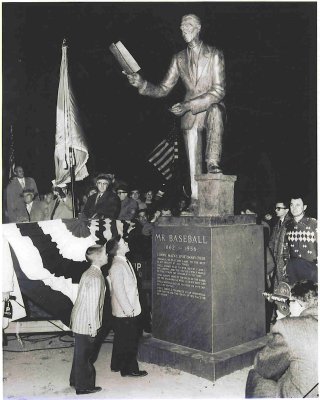
When Rosin was finished his work, he had created a 13-foot masterpiece. The statue of Mack himself rose eight feet high and was placed on a pedestal five feet in height. The question as to the pose of Mack was easy to answer. The most vivid image everyone had of him was with one foot in the dugout and one foot on the top step of it waving his trademark scorecard to position A’s players in the field. There is Mack, his gaunt body leaning forward from the dugout, holding the scorecard in his right hand, directing his players as he had done for 50 years. Despite the fact that the A’s manager lived to the ripe old age of 93, Rosin decided to portray him as a much younger man. The image of Mack depicted on the statue is reminiscent of his appearance during the second dynasty period (1929-1931) when he and the Athletics were experiencing their last blaze of glory on the baseball diamond.
The site selected for the statue was a park opposite Shibe Park/Connie Mack Stadium just across Lehigh Avenue. Known as Reyburn Park after former mayor John Reyburn, Philadelphia’s City Council passed a resolution changing the name of it and the adjoining Funfield Recreation Center to “Connie Mack Park and Recreation Center.”
The Dedication Ceremony
The decision was made to dedicate the Mack statue on 16 April 1957 in a pre-game ceremony starting at 7 PM before the Phillies’ home opener. Baseball Commissioner Ford Frick and American League President Will Harridge were in attendance along with former Athletics players, well known as “Mr. Mack’s boys.” They included Joe Boley, Rube Walberg, Howard Ehmke, Mule Haas, Cy Perkins, Bing Miller, and Frank “Home Run” Baker. In addition, letters and telegrams from President Eisenhower, former President Hoover, Bob Hope, Ty Cobb, and other celebrities had been received to mark the occasion and were read during the dedication ceremony. Phillies’ broadcaster Bill Campbell was the Master of Ceremonies.
The chore of actually uncovering the statue—removing the veil that draped it—was given to two of Connie Mack’s great-grandchildren. They were 10-year old Earle McGillicuddy 3d of Newtown Square and 8-year old John Robert McCambridge of Wilmington.
The ceremony itself was relatively brief but conducted with great reverence. The Police and Firemen’s Band opened the ceremony by playing “The Star Spangled Banner.” The invocation was delivered by the Very Reverend Monsignor Thomas J. Riley. Remarks were made by Frick, Harridge, Major Richardson Dilworth, and baseball noteworthy Leo Durocher.
A writer for the “New York Times” caught the spirit of the moment when he wrote for readers of the newspaper the next day, “For more than 50 years the genius and geniality of Connie Mack held sway in that park (Shibe Park/Connie Mack Stadium). Triumph and tragedy were his in that setting. There he built up magnificent, all but invincible, teams.”
Following the dedication ceremony, the crowd crossed the street to watch the Phillies take on the Brooklyn Dodgers. A crowd of 37,667 saw the Dodgers edge out the Phillies 7 to 6 in extra innings when Gino Cimoli hit a 12th inning home run off Robin Roberts that proved to be the difference in the game.
The Years Pass and Things Change
Like the Philadelphia Athletics, Shibe Park/Connie Mack Stadium didn’t last forever. When the Phillies vacated the facility after the 1970 season and moved to their new home in South Philadelphia, a decision was made to take the Mack statue along. According to information provided by Phillies’ Vice President for Public Relations, Larry Shenk, the generosity of Charles Young of George Young and Company made the statue’s relocation possible. The Connie Mack statue was rededicated on 21 August 1971 at the corner of Broad Street and Pattison Avenue in front of Veterans Stadium.
Like Shibe Park/Connie Mack Stadium, Veterans Stadium also had a date with the wrecking ball. The Mack statue was moved again in early 2004 as preparations got underway to implode Veterans Stadium. The Phillies, according to Shenk, had the statue cleaned, waxed, and polished as part of a re-patina project. The statue was then moved to its current location on Citizens Bank Way in March 2004 in time for the grand opening of Citizens Bank Park.
The Phillies also added a plaque to the statue’s pedestal listing all of the Philadelphia Athletics players who were chosen between 1978 and 2003 for the Philadelphia Baseball Wall of Fame located in the 200-level concourse of Veterans Stadium. The plaques of the individual A’s players that once hung in Veterans Stadium can now be seen at the Philadelphia Athletics Society’s museum where they help represent the glory of that fabled team.
Shenk also notes that the Phillies placed a plaque in front of the statue once it was moved to its current location to give visitors a sense of Mack’s importance to Philadelphia’s baseball history. The plaque reads:
“Connie Mack managed the Philadelphia Athletics for 50 years, 1901-50. His teams won nine American League pennants and five World Series. Mr. Mack never wore a uniform, preferring to manage in street clothes while holding a scorecard to signal his players. This statue was unveiled near Connie Mack Stadium on April 16, 1957, moved to Veterans Stadium in 1971 and relocated here March 30, 2004, just before the opening of Citizens Bank Park.”
The Sportsman Creed
On the base of the Mack statue is carved “Connie Mack’s Sportsman’s Creed.” It reads:
“I promise to play the game to the best of my ability at all times.
I will always play to win, but if I lose I will never look for excuses which would detract from my opponent’s victory.
I will never take unfair advantage in order to win.
I will always abide by the rules of the game on the diamond as well as in my daily life.
I will always conduct myself as a true sportsman should, on and off the ballfield.
I will always strive to play for the good of the entire team rather than for my own glory.
I will never gloat in victory or pity myself in defeat.
I will judge a teammate as an individual and never on the basis of his race or religion.”
A Final Thought
When the Connie Mack Memorial Committee asked fans to contribute funds to erect a lasting tribute to Mack, it said the statue would make Connie Mack “live for more than a hundred years…in memory.” Almost a half century after Connie Mack’s death, the statue has accomplished that and more.