Chief Bender: A Marksman on the Mound and in the Traps
 By Bob Warrington
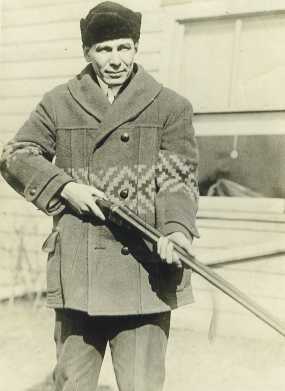
“Like 95 percent of the baseball players and fans, I find my chief recreation away from the diamond in the gun.” So wrote Charles Albert “Chief” Bender in a 1915 article describing what players do to relax and hone their baseball skills during the off-season.
Bender pitched for Connie Mack and the Philadelphia Athletics from 1903-14. He was a key member of the A’s “First Dynasty,” which from 1910-14 won four American League pennants and three World Series championships. Mack considered Bender his “greatest one-game pitcher,” and was quoted as saying, “If everything depended on one game, I just used Albert, the greatest money-pitcher of all time.” Chief Bender was inducted into the National Baseball Hall of Fame in 1954. But, his love of the sporting life extended beyond the diamond.
Shooting has always been popular with baseball players, whether in the Great Outdoors hunting game or in trapshooting where flying clay birds are the prey of choice. Those who have written of players’ fondness for shooting are quick to point out that the two sports require similar abilities. “Ball players like the sport,” Bender commented in his article, “because it is a clean and inspiring means of recreation. The practice at the traps not only provides a certain amount of physical exercise, but it also trains the eye and mind, develops self-control, and brings the player into close communication with the best type of sportsmen in the world.”
An article in a 1916 issue of The American Shooter magazine described the relationship this way. “For shooting and baseball are two of America’s “best bets” in the sports world. Both require a steady nerve, good eye, even temperament, concentration, and A-1 brand of sportsmanship. Indeed, they have many things in common.”
That same article listed a number of baseball players of the period who were particularly ardent and capable in the sport of shooting. In addition to Bender, Hall of Famers Ty Cobb, Christy Mathewson, Eddie Collins, Honus Wagner, Roger Bresnahan, Fred Clarke, Frank Baker, Grover Alexander, and others were identified as “scarcely able to wait until the diamond season is ended so they may rush to the gun rack, select their favorite firearms, and strive for records at the traps or in the pursuit of game.”
A 1916 issue of Trapshooting magazine echoed the theme that sport shooting during the off-season would actually improve a baseball player’s skills. Using Bender as its example, the magazine noted that he had in 1915 “a rather disappointing deflection to the ranks of the late, unlamented “outlaw” league.” (The Chief pitched for the Baltimore Terrapins of the Federal League that year and notched a most uncharacteristic record of 4-16 for a terrible team that finished in last place with a 47-107 record.)
Trapshooting predicted that the former ace would return to form after an off-season of shooting clay bird targets. “The Chief has persistently stuck to the clay bird game—the sport that, more than any other, keeps eyes keen, steels the nerves and cultivates instant and accurate judgment of speed, distance, the effect of wind, etc.; things that are invaluable to a pitcher.”
Perhaps it did help. Bender climbed back to the .500 level with a 7-7 record for the Philadelphia Phillies in 1916 and notched an even better tally of 8-2 the following year. His major league baseball career was effectively over at that point, however.
Bender’s love of target shooting and prowess with a gun were remarkable. “I have been shooting clay targets for about 13 years,” he wrote in 1915, “and with every visit to the traps the fascination grows. I always endeavor to outdo my previous efforts and this leads to a gradual improvement in my shooting.” The typically stoic Bender’s joy on the firing line also was evident. “A string of broken targets will make the Chief as gleeful as a debutante who has just received her first invitation to a dance,” one journalist declared.
There is no doubt trapshooting and hunting played a large role in Bender’s life off the baseball diamond. Both of his biographers acknowledge that Bender was one of the best marksmen—target and live game—in the country. Contemporary sources include numerous mentions of Bender’s enjoyment pursuing game with gun and dog in the Great Outdoors or shooting in the “traps” and setting records for targets hit. One noted, for example, “He (Bender) is an exceptional marksman, and has won almost as much fame with his shotgun as he has pitching a baseball.”
But shooting wasn’t all about fun and relaxation. It had a business side as well. At one point, Bender was ranked among the top ten professional trapshooters in the country. Recognizing the promotional benefits that could be accrued by having him serve as spokesman for its product, Bender was paid for a time by the Winchester Arms Company to tour around the country giving target shooting demonstrations and extolling the virtues of that company’s shotgun for hunting and target practice.
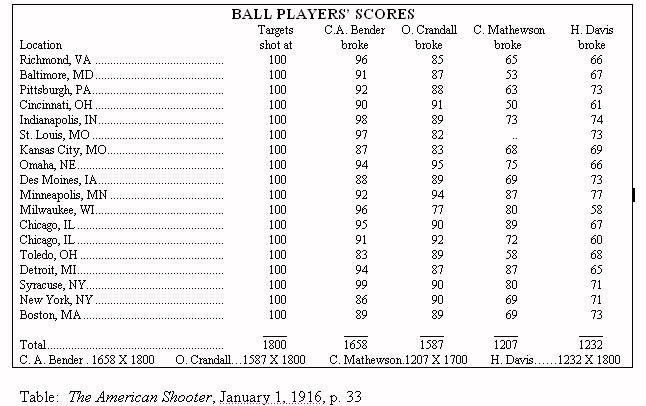
But, how good was Chief Bender as a marksman compared to other baseball players of his era? The E. I. du Pont de Nemours Company organized a tour following the 1915 baseball season in which four players were selected to visit a number of Eastern and Midwestern cities and compete in shooting clay birds (also referred to as “clay pigeons”). The tour’s purpose was to “awaken great enthusiasm for the sport (target shooting),” and it was widely publicized. One account of the tour reported, “Large crowds attended the matches.”
Chief Bender was one of the players selected to compete. Christy Mathewson (New York Giants), Harry Davis (Philadelphia Athletics), and Doc Crandall (St. Louis Terriers – Federal League) rounded out the quartet. Eighteen cities were visited on the tour, and at every stop, each player shot at 100 targets trying to smash the elusive clay discs. The accompanying table lists the tour locations and scores for the players.
As it shows, Chief Bender bested his rivals, leading his closest competitor (Crandall) by over 70 targets hit. In addition to achieving the highest average of targets struck (.9211), Bender notched the two highest individual scores, smashing 99 clay pigeons in Syracuse, New York, and 98 of them in Indianapolis, Indiana.
On another occasion, however, Chief Bender’s shooting skills almost got him arrested. The Athletics did their spring training in Marlin, Texas in 1907, and one day a big, black buzzard hovered over the practice field. Grabbing a rifle, Bender brought the bird down with one shot, explaining that the team was not so moribund to attract such a creature. The next day, the local sheriff appeared to arrest the Chief, declaring that it was illegal to shoot vultures in the area. It took all of Connie Mack’s diplomacy and tact to save Bender from going to jail.
In addition to trapshooting, Chief Bender was an avid hunter. It wasn’t all about the kill for him, however. He once told a fellow hunter, “The best part of hunting is really in just sitting still in the woods, observing the antics of the small animals and birds in their casual moments and otherwise communing with nature.” Reflecting his Chippewa heritage, Bender also observed that “Indians were taught conservation and love of the outdoors and wildlife from an early age, and said if a man thought only of killing when hunting deer or any other kind of game, he was wasting his time and should stay home.”
When Chief Bender died in 1954, obituaries written about him referenced his “outstanding” skills as a marksman. But, how did Bender feel about all those years he spent during the off-season in the Great Outdoors? He offered a rueful observation late in life. “Practically all I did was hunt and fish, but in those days it was not impressed on our minds that we should prepare ourselves for the future. Today, all the fellows are interested in learning or lining up some business for the time when they can no longer play. They also have a pension.”
Perhaps Chief Bender spent too much time in the traps during the off-season and regretted not paying more attention to nurturing a post-baseball business career. Yet, his devotion to target shooting and the abilities he displayed in that sport enabled Bender to be declared, “King of the Ball Players at the Traps,” by The American Shooter magazine. That honor meant a lot to him, as did the honor of being inducted into the National Baseball Hall of Fame. Together, they affirmed what Bender regarded as his greatest legacy—being remembered as a true sportsman.
Resources
Chief Bender, “Ball Players as Shooters” (March 6, 1915), Bender file, National Baseball Hall of Fame Museum and Library, Cooperstown, New York.
“Chief Bender Dies; A Famous Pitcher,” New York Times, May 23, 1954. Associated Press Biographical Service, “Biographical Sketch of Charles Bender” (May 15, 1942), Bender file, National Baseball Hall of Fame Museum and Library, Cooperstown, New York. Mack always referred to Bender and addressed him using his middle name, “Albert.” “Chief Bender, Hall of Fame Pitcher, Dies,” New York Herald Tribune, May 24, 1954.
Bender, “Ball Players as Shooters.”
“Ball Players Hit ‘Em With a Gun,” The American Shooter (January 1, 1916), 33.
Ibid.
“Chief” Bender Goes Back to O. B. (Organized Baseball),” Trapshooting, ed. Samuel Wesley Long (1916), 93.
Ibid., 94.
Bender, “Ball Players as Shooters.”
Trapshooting, 94.
William C. Kashatus, Money Pitcher: Chief Bender and the Tragedy of Indian Assimilation (University Park: Pennsylvania State University Press, 2006), 140. Tom Swift, Chief Bender’s Burden: The Silent Struggle of a Baseball Star (Lincoln: University of Nebraska Press, 2008), 11-14. Even Connie Mack’s biographer notes that Bender “was one of baseball’s greatest trap-shots.” Frederick G. Lieb, Connie Mack: Grand Old Man of Baseball (New York: G. P. Putnam’s, 1945), 84.
The story originally from which this quotation is taken appeared in Baseball Magazine in June 1911. It was reprinted in the magazine in 1956. “Flashback: Chief Bender,” Baseball Magazine (August 1956), p. 50.
“Charles Albert (“Chief”) Bender” biographic sketch. Bender file, National Baseball Hall of Fame Museum and Library, Cooperstown, New York.
J. G. Taylor Spink, “A Long-Delayed Feather for the Chief,” The Sporting News, December 30, 1953.
American Shooter, p. 44.
Ibid.
Ibid.
Spink, “Long-Delayed Feather for the Chief.”
Earl L. McCormick, “Dinner with the Chief,” South Jersey Magazine (winter 1992), 52.
Ibid.
“Chief Bender Answers Call to Happy Hunting Grounds,” The Sporting News, June 2, 1954.
Spink, “Long-Delayed Feather for the Chief.”
American Shooter, 33.