Bob Savage Tells His Story
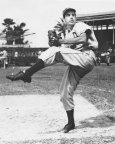
I was born John Robert Savage on December 1, 1921 in Manchester, New Hampshire. Prior to 1939, life was quite normal and I played all sports living in a large neighborhood in Manchester. I would say there were at least 40 to 50 kids in a four square-block area. When I was about nine or 10, I played on the Hilltop 4th team. We played a four-team schedule in baseball and football during the summer and early fall. My brother was three years older so he played with his age group on the Hilltop 2nd team.
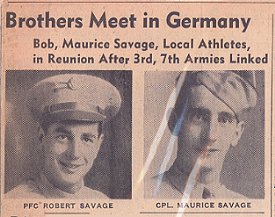 In 1935, I made the varsity baseball team as a freshman at St. Joseph’s High School, where I became a regular starting pitcher all four years. I also played four years of basketball, including two years on the varsity team. I participated as well in freshman football before my baseball coach made me stop.
After graduation in 1939, I spent the summer playing with the Atlantic Oilers in the City Twilight League. I was just a good pitcher, winning more than I lost, but no big deal.
My dad had a friend in Washington, D.C., who told him about Staunton Military Academy in Staunton, VA. The school featured strong academic and sports programs, plus they were strict on discipline. I found myself on the campus by early September in 1939 since I needed academics and discipline and saw this as a good chance to find out how strong I was in baseball. At the beginning of the spring schedule, I was the fourth-ranked pitcher, but ended up ranked No. 1.
The summer of 1940 had me back with the Oilers, where I pitched much better. I made the All-Star team and beat the Concord All-Stars, 1-0, on a one-hitter. That summer I had been working in the Manchester City Yard for 40 cents an hour ($18.40 per week) making hot top for roads. Fortunately, as a result of the All-Star game, I was offered a job playing baseball for $25 a week, plus room and board, in a summer semi-pro league in Groveton, located in northern New Hampshire. I was on the bus the next day. I didn’t pitch much for Groveton that summer, and I never really knew the reason.
Signing with the Athletics
The following September, I headed back to Staunton Military Academy on a full scholarship. I had a sensational season in 1941 and many baseball scouts offered all kinds of proposals. Ira Thomas of the Philadelphia Athletics made a good pitch, but with the help of family and friends, I decided to go with Detroit. However, the Tigers never followed through on their proposal with a contract.
That summer I played with Claremont in the Northern League. The team was coached by Jeff Tesreau, a great pitcher for John McGraw. Tesreau’s friend, Paul Critchell, a Yankees scout, made a slight pitch for me, but I didn’t think the offer was good enough. I decided to go back to SMA in 1942 to see what would happen. If Ira Thomas showed up, I was going to accept any proposal providing I would stay with Philadelphia until Uncle Sam called me for duty.
That year, SMA had another great season, finishing as state champs. Over the seasons at SMA, my record was 22-1-2 with an average of two strikeouts per inning. Ira Thomas did come back, and I signed with the Philadelphia Athletics for $100 per week and a $1,200 bonus. I would stay with the big-league team the entire season. In 1942, I pitched in eight games, including starting the last three. Although my overall record that year was 0-1, I think I made a good impression.
But the attack on Pearl Harbor had taken place the previous December, so my thoughts about the war became foremost in my mind. I had competed three years of Military Science and Tactics at SMA, so the draft board allowed me to go back and finish that four-year course. Early in March, Gen. McCabe, the superintendent of SMA, summoned Steve Early (his father was a key aide to President Roosevelt in the White House), Cliff Parisi, Red Alfast and me into his office. Gen. McCabe said that if we enlisted at this time, we would go to Richmond for the swearing in, get processed at Camp Lee, and then head for Officers Candidate School at Fort Benning. The plan sounded right and was endorsed by Gen. McCabe.
World War II Service
On March 10, 1942, we joined the Army. Everything went right except for one glaring mistake. Steve Early was the only one of us sent to OCS; everyone else ended up at Camp Wolters, Texas, for 13 weeks of basic training. I never knew why that happened. It was a tough 13 weeks but may just have saved my life.
As far as baseball, I played a couple of games for the camp’s team. One game was against Waco Air Base that Birdie Tebbetts managed. Birdie asked me to play for his team if it could be arranged, and I told him to make the necessary arrangements. A year later, when I was in combat, the deal was made. But, no, I didn’t leave the war zone.
After basic training, Alfast was shipped to Alaska, and Cliff and I were sent to a staging area outside of Youngstown, Ohio (I believe it was called Shanango). We remained there for about three weeks and then were sent to the port of embarkation at Norfolk, VA. I don’t remember the dates, but Cliff and I got on a ship that was headed to Casablanca, where we stayed for a week. Life there was like looking at pictures in a Bible.
Later, we were packed into freight cars for a trip to Oran. It was so crowded in the car that Cliff and I tied our blankets together and made a hammock. This was fine the first night, but on the second day Cliff bought three bottles of wine from an Arab lady. We drank it all. That night, both of us ran in and out of our beds much to the annoyance of guys trying to sleep. We never got our popularity back.
After a week in Oran, Cliff and I were shipped to a replacement center in Naples, Italy where we found out where we would begin our actual combat duty. I was assigned to Company D, 15th Infantry Regiment, 3rd Infantry Division (Incidentally, Audie Murphy was a sergeant in Company C.). Cliff was assigned to Company D, 30th Infantry Regiment, 3rd Infantry Division. Cliff and I were separated here. We saw each other only one more time during a chance meeting about five months later. I never saw Early or Alfast again.
It was quite lonely for a short time with my friends no longer with me. My new home was in the town of Conserta, which faced Mount Casino. The Germans had occupied a Benedictine monastery on top of the mountain and held off the allied troops for several months.
My outfit left Naples and traveled by trucks about few miles short of our destination. The rest of the journey was on foot. Sometime during this walk, the enemy sent a barrage of mortar fire into our line of troops. Several of our boys were killed. I got hit in the back. Luckily, I had put everything but the kitchen sink in my knapsack, It got torn to pieces, but just a small amount of shrapnel lodged in my back. It seemed that it wasn’t very long before medics got to us and moved the wounded to a safe area. There was an aid station very close to the front. We were all examined and then sent to a MASH-type hospital where the shrapnel was removed from my body. From there, we were sent to a hospital near Naples.
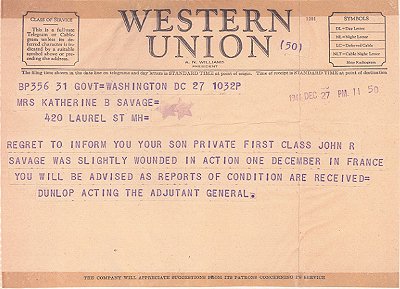
As best as I can remember, this had to be early December 1943. My wounds didn’t heal too fast and the pain remained. After additional X-rays, doctors found that some shrapnel remained behind the scapular area of my shoulder. A fluoroscopic operation was needed and that meant a trip to Walter Reed Hospital in Washington, D.C. I headed to Algiers for final disposition on Christmas Eve. Meanwhile, U.S. troops landed at Anzio (January 1944). Now Walter Reed seemed unreal, and it was.
After about a month in Algiers, I was sent back to the replacement center in Naples. That’s when I ran into Cliff, who had been shot up pretty bad and was heading home. A few days later, I was put on a boat for an overnight trip to Anzio, and I finally met the folks that would be my comrades for the rest of the war. This was in late April in 1944, and I had yet to receive any mail since I left the United States.
Our company was stationed on the line about 100 yards from the enemy. There was absolutely no movement on either side of the frontline during daylight. All movement was at night. We were on line about 10 days when our battalion moved back to the beaches for a rest. The Anzio beachhead was about 10 miles deep and 12 miles long. The ocean was at our backs, and mountains surrounded us.
While we were at rest, the company formed a baseball team and scheduled a game with an ordinance outfit. The Company Commander, Capt. Stocker, had been a catcher in the Three I League. There were thousands of dollars bet on the game (I hadn’t had a payday in six months, so I was pure that day). I pitched a no-hitter, and our guys won all the money, especially my catcher-the captain.
On the way back on the truck, the Captain came to me and asked, “Bob, what can I do for you?” I told him I still had shrapnel in my back, and the tripod for the heavy machine gun was tough for me to carry. (The machine gunner carries the tripod on his shoulders when it is moved from one place to another.) The Captain said, “Would you like to be my driver?” From that day on, my life expectancy improved. This was my second break in disguise.
For my first bit of driving, I was on detached service with a chemical mortar battalion transporting ammunition to the outskirts of Rome. I was traveling behind them when I came to a fork in the road. I went left when I should have gone right. I didn’t realize my mistake until I got into the square in Rome that Mussolini once used when he gave speeches. I turned around and started my retreat only to spot our 5th Army coming toward me. I told the lead vehicle not to worry because I had chased the enemy away. (The Germans had vacated the city earlier that day.)
The next day I was at a stop sign with an Italian lady seated next to me. At the time, there was a no-fraternization policy in effect. When General Mark Clark, Commander of the 5th Army, who was officially coming into the city to take possession, passed me, he smiled and then saluted me! The next day, I left the chemical mortar battalion and returned to my company.
On arrival, I was told to get ready for inspection. I begged my sergeant to send me elsewhere so I could escape the inspection. There was no way that I could clean my jeep (it had not been cleaned since it landed in Africa with the 3rd Division a few years back) and myself in time. He sent me to Division Headquarters at the University of Rome.
En route, I was following a truck that stopped suddenly, and I didn’t. I guess I was guilty of sightseeing. With a damaged radiator, I got towed to the university and reported to the Captain, who was supposed to be my passenger. He was very understanding and told me to report back when the jeep was fixed.
Three days later, he put a lieutenant’s bar on my shirt collar, and we toured Rome for the next several days. The Captain and I joined the division in Naples to prepare for the landing in southern France. We took Rome on June 4th, and the Allied invasion of Normandy had taken place two days later. Now, we had to learn the French language because that is where we were going.
At this point, the war changed significantly for me and my unit. The vehicles were loaded on the ships before the troops came aboard. We sat on the ship in Naples for 30 days before taking off for France.
As we were leaving Naples, Winston Churchill arrived at the harbor on a small boat and gave the victory sign to each ship in the convoy. The landing in southern France took place in August 1944 (Operation Dragoon) and was relatively easy. The GI’s advanced about 25 miles the first day, which stood in stark contrast to being bogged down for days at a time in Italy. After our unit landed in San Tropez, France, we moved about 20 miles every day. Every now and then the enemy would set up on high ground. They would take several artillery shots at us to slow us down and allow their side to retreat more easily. Rear actions like this would gain them as much as a half-day of travel time. Our group reached the Rhine River three times (using different routes) before we finally crossed the river.
On my birthday, December 1, 1944, I was waiting to cross a small stream that had a one-way temporary bridge along the Rhine River. While waiting for traffic to go in my direction, I was standing next to my jeep, when an artillery shell landed close by. I hit the dirt but still was wounded on my leg, wrist, and face.
When I got up, I realized I still had to get the jeep across the stream. I was able to drive to my destination, which I think was no more than a mile away. I was taken to an aid station nearby and then transported to a hospital by an ambulance that had to pass over the same bridge where I had been wounded. Fighting had settled down, so we had no trouble during our journey. I was on the mend fairly soon after surgery, but I remained in the hospital for about six to eight weeks.
Pictured at the wheel of the American jeep above,somewhere in France, is PFC John R. (Bob) Savage), star baseball pitcher, son ofMr. and Mrs. Maurice F. Savage, 461 Maple Street, who was wounded for the second time on his birthday, December 1st, according to the official notice and from a letter from the soldier. The expression on the faces of the natives and the huge bouquet of flowers on the jeep, to Savage’s right, vividly express the reception the American received.
While I was recuperating in the hospital, and since I could get around OK, I worked as a helper to Father Conlon, the Catholic Chaplain. He was a wonderful man from New York City. (You must believe the saying, “There are no atheists in foxholes.” Because it’s true.) Father Conlon swore like a trooper, and I remember that I kept correcting him.
I returned to my company after it crossed the Rhine, and the war was winding down. I got hit a third time shortly after I returned to action. This time, I was in a foxhole when a shell hit a tree and a flat piece of it hit me on the top of my head. This caused a pretty large bump. I went to a first-aid station and the medics gave me a pill and sent me back to my unit.
This injury did count for my third Purple Heart, but it was my lucky one. On the last day of the war, everyone was firing their rifles in the air and a spent bullet knocked my helmet off. I spent the rest of the day indoors.
A few days before the end of the war, our division liberated the Dachau Concentration Camp. This has to be my worst memory. I haven’t spoken about this experience more than ten times in the last half century and probably will not speak about it again. Our unit ended the war in Saltzburg, Austria.
About ten days later, there was a call for baseball players to form a division team and I joined. Our home field was a fair grounds in Saltzburg where we played for about a month. In July 1945, the division moved to a town outside of Frankfort. I pitched pretty well and the competition was keen. I left for home in early September I was discharged on September 30, 1945.
Back With The A’s
On January 10, 1946, Dorothy and I were married. Since she was a Southern Baptist and I was a Roman Catholic, we believed there would be a problem getting married in the Catholic Church. But, Dorothy took the bull by the horns and, before I got discharged, she started taking lessons to convert to Catholicism. She finished in time for our wedding date. The ceremony took place in the only Catholic Church in Staunton, VA with just close friends and Dorothy’s family in attendance. My best friend, Harry Dey, who was my coach at the Staunton Military Academy, was the best man. My wife’s best friend, Miss Campbell, was the maid of honor. After the ceremony, we went to Washington, DC for a few days, and then to New Hampshire so she could meet—for the first time—her new in-laws. We had a good marriage for 22 years and produced two great kids, Bobbie Jo and John Jr.
The next challenge I faced was making the A’s team in 1946. We had very few carry-over players, but over 50 pitchers arrived for spring training to compete for 10 spots. I received a contract for $2,500, but that turned into $5,000 by the end of the season. One point I would like to emphasize is the difference in players’ attitudes in 1946 compared to 1942 when I was last with the Athletics. In 1942, except for the pitchers and coaches, not one of the other players ever spoke to me. I didn’t hear a single word from them from the time I arrived in May 1942 until the end of the season. Evidently, this was the way all rookies were treated in baseball at that time. However, in 1946, such foolishness wasn’t practiced anymore, and all the players on the A’s liked and cheered one another.
At the end of the 1946 season, I had a 3-15 record with an ERA of 4.06. In 1946-47, I pitched in more ball games than any other pitcher in the American League. I performed as both a starter and reliever. (One must remember that when you give up one run in one inning in relief, it equates to nine runs on your ERA.) There are five or six games that I remember fairly well. My three wins were complete game starts against the Yankees (two wins) and the Tigers. I lost two complete game starts against Bob Feller of the Cleveland Indians. One was by a score of 1-0, and the other was a 10-inning game that ended 2-1 . I lost another 10-inning game on September 1st to the Red Sox. That happened to be on “Bob Savage Day” in Fenway Park. Another game I lost was a rain-shortened affair with the Yankees. It was called after five innings with the score 1-0. Although my won-lost record might not show it, I believe 1946 was by far my best year in baseball.
Bobo Newsome and I were close friends on the Athletics. He took a liking to me in spring training and spoke up for me to Mr. Mack on many occasions. He got Dorothy and me a cellar apartment at his apartment house, and we drove to the ballpark together. Bobo and Earle Brucker took very good care of us. All the members of the pitching staff were friends, but my roommate, Russ Christopher, and I were real close. We met for the first time in Richmond, VA when I boarded the team train for spring training.
After the 1946 season, I enrolled for the fall semester at St. Anselm’s College under the GI Bill of Rights. The college is located in my hometown of Manchester NH. I returned for the fall semester each year through 1949. The other big event in 1946 was the birth of my beautiful daughter, Bobbie Jo, on December 27th.
In many ways, 1947 was very much like 1946, except that my luck was a little better and Eddie Joost helped me get out of trouble more often than was the case in 1946. Three games, in particular, come to mind. In one stretch during the season, I started three games against the Yankees, Indians, and Tigers and won all three games. At that point, I was shifted to the bullpen because I had tired during the third game. I accepted this switch because I enjoyed pitching often. I really think I had a rubber arm, and I can remember only one sore arm during my entire career. I ended the 1947 season with an 8-10 record and an ERA of 3.76.
My last year with the Philadelphia Athletics was in 1948. Although I had a record of 5-1, my ERA blossomed to 6.21. I think this was the worst year I had in baseball. The thing I remember most is that after the third game of the season, I led the league in batting and pitching. We opened in Boston and swept the series. Not only did I win the third game, I also got the winning hit and RBI. I was batting .1000 and pitching .1000. About late July, I had a few bad outings and Mr. Mack didn’t use me for about two weeks. We were playing at home at the time, so I went to his office and asked him why he had stopped me. Mr. Mack responded, “Bob, I heard the crowd booing you for the first time since you started pitching for me, and I thought I would wait until we got back on the road before I pitched you again.” That answer floored me, but as I realized later, Mr. Mack’s concern about his players’ feelings was one of the reasons we all loved him so. I don’t remember my answer to him, but I hope that my reaction was as gentle as his response. The A’s, by the way, had a great year in 1948. We were in the pennant race for much of the season and wound up in fourth place. Each player on the A’s got a check for $400 for our 4th place finish.
Baseball After The A’s
During the following winter, I was traded to the St. Louis Browns and went to spring training after a salary dispute and holdout. I finally signed for the same money I had gotten in Philadelphia, $8,000. Seeking that much from the Browns was really a mistake on my part. Come cutdown day, they were not going to keep an $8,000 pitcher when they could lose the same game with a $6,000 pitcher. In those days, the Browns were the worst team in baseball. So, when cutdown day arrived, my contract was sold to Cleveland, and they sent me to San Diego, CA in the Pacific Coast League.
I joined the team in San Francisco on a Sunday morning in time to play in both ends of a doubleheader. Bucky Harris was the manager of the Padres and the coaches were John Corrigan and Jimmy Reese. The Yankees had fired Bucky and John after the 1948 season for failing to win the American League pennant. I did a lot of pitching that summer, both starting and in relief, although I finished the season strictly as a relief pitcher. Some of the players on that team were Minnie Minoso, Max West, Al Rosen, Luke Easter, Jesse Flores, Jack Graham, Al Smith, and Whitey Weitleman.
I was again with the Padres for the 1950 baseball season, but the team had a new manager. Del Baker took Bucky’s place, and the real good times turned into fairly good times. Over the 1950-51 winter, Jack Graham and I were traded to Lefty O’Doul’s San Francisco Seals. In June 1951, the US Government issued a directive to the effect that if you were going to school under the GI Bill of Rights and had discontinued your studies for any reason, then you had to resume them by July 1st or lose the benefit forever. Well, after attending St. Anselm’s College for four semesters, I had dropped out. Now, a big and most difficult decision had to be made. Feeling I would not get back to the big leagues, I chose to go back to college for the remaining four semesters and get my degree.
I went to the Seals’ management and requested a leave of absence to pursue my studies. It was granted with the proviso that I return for part of the 1952 season. I went to summer school and the fall college semester in 1951, and the spring college semester in 1952. I returned to the Seals during the 1952 season without having any spring training. They asked me to go to their farm team in Yakima, Washington to get into shape. As it turned out, the Seals had a terrible season while the Yakima club had a real good one. I remained on the farm team as a relief pitcher throughout the 1952 baseball season. The fans called me “Mr. Save-age.” After the season, I went back to St. Anselm’s for my last semester of study and eight weeks of practice teaching. Returning to San Francisco again in 1953 without any spring training proved just too much, so I was given my release and went home to graduate with my class in June 1953.
Life Beyond Baseball
Since I was only 31 years at the time and have 47 more years of my life to account for, I’ll just highlight the rest of my story. My dad was in hospital supply business, so I worked for him for awhile. By luck, I ran into my old friends Lefty Gomez and Lefty Nelson at a baseball function one night, and they asked me to join the Wilson Sporting Goods Company. I did and was assigned Vermont, New Hampshire, and lower Maine to sell golf equipment to pro shops in the summer and other sporting goods equipment to schools the rest of the year. On occasion, Gomez and I would conduct clinics and do other sporting goods promotions. Next to my Father and Connie Mack, Lefty Gomez was the nicest man I ever met.
Following my career with Wilson, I opened a sporting goods store and hotel with my brother, Maurice. In 1969, I married Rita King Lyons and began teaching physical education and coaching several sports at Gorham High School in Gorham, NH. Rita was a widow with two children—Kathy who was 12 and John who was 10. So, by marrying her, my family doubled in size and now included two Johns—John Savage and John Lyons.
My final career was in politics. In 1983, I ran for and was elected to the position of Clerk of the Probate Court (Register of Probate). I retired after two terms on January 1, 1986 to enjoy the golf courses of northern New Hampshire and Myrtle Beach, SC. I hope you’ve enjoyed reading my story as much as I’ve enjoyed telling it. Thanks for your patience.