Bing Miller: “Old Reliable”
 By Dale B. Smith
Dale Smith besides being a valued member of the A’s Society contributes many fine articles such as this on a regular basis.
One might think that Bing Miller felt a certain since of destiny as he stepped to the plate in Game 5 that October 14th afternoon in 1929. After all, it is not everyday that a batter can win a World Series with a ninth inning, walk-off base hit. Mule Haas had hit a two-run home run in the bottom of the ninth and the Chicago Cubs and Philadelphia Athletics were now tied 2-2 with the A’s ahead in the Series, three games to one. Then Al Simmons nearly homered as his drive hit the outfield scoreboard and Al settled for a double. Following Simmons, Jimmie Foxx may have been destiny’s child but with first base open he was intentionally walked.
With Simmons and Foxx on second and first, steady, reliable, easy-going, thirty-five year old Bing Miller approached the plate. With a solid hit to the outfield wall, he could send the hometown Philadelphia faithful into delirious jubilation. The odds of most at bats, however, would favor the game going into extra innings and perhaps give the Chicago Cubs a chance to win the game and the World Series back on their home turf. Maybe Bing Miller was thinking that he was a long way from Vinton, Iowa.
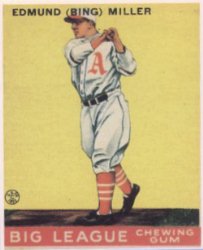
Edmund John Miller was born in that small, Iowa farming community on August 30, 1894. Born in the East Central region of the state now famous for its Field of Dreams, 19 year old Bing Miller started his professional baseball career at Clinton, Iowa in 1914. After several years it looked like Bing’s big league dreams might not come true. After seven years in the minor leagues, Bing (nicknamed after a cartoon character) got his opportunity with the Washington Senators in 1921. The 26-year old rookie made an impression on Philadelphia Athletics manager Connie Mack.
Mr. Mack was looking for a way to escape seven straight last place finishes when he traded with the Senators for Bing Miller in 1922. Bing provided immediate results, hitting a career high 21 home runs and batting .335, fourth and fifth highest respectively among American League batters. He also began to establish his reputation as a fleet footed outfielder with a strong arm. The Athletics escaped the American League cellar with a seventh place finish. Bing Miller and infielder Jimmy Dykes were now cornerstones on which Connie could build a pennant contender.
In only three years the Athletics were battling for the pennant in 1925. They finished second after a long losing streak near the end of the season. In 1926, with a pennant so close he could taste it, Connie Mack was looking for changes. 30-year old Bing Miller was traded to the St. Louis Browns. It quickly became the one trade that Connie regretted making and almost immediately he began looking for ways to get Bing Miller back. Bing, meanwhile became a hitting star for the Browns although they languished in second division in 1926 and 1927.
Mr. Mack traded again for Bing Miller on December 13, 1927, giving up pitcher Sam Gray in the process. Now 33, the question was: Would Bing be too old to help bring the A’s a pennant? He was certainly younger than the cast of 40 plus year old future Hall of Fame outfielders that Connie had been experimenting with; Ty Cobb, Zack Wheat and Tris Speaker. Bing Miller replaced Speaker and rookie Mule Haas replaced Ty Cobb whose legs were giving out. In 1928 the great outfield of Al Simmons in left, Mule Haas in center and Bing Miller in right was born. The team was one year away from their destiny.
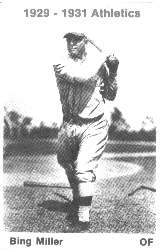
Following a second place finish in 1928, the Athletics’ 1929 race for the pennant was virtually unchallenged. At an age when most players were relegated to pinch hitting duties, “Old Reliable” Bing Miller, now 34, had a career high 183 base hits while hitting .331. He led the Philadelphia A’s with 24 stolen bases and 16 triples.
In the 1929 World Series against the Cubs, Bing hit .368 with seven hits in five games. Still noted as being one of the most memorable and exciting Series despite its apparent lopsidedness, the Series could have easily gone to Chicago. Even after the miraculous 10-8 comeback victory in Game 4, a Cub’s victory in Game 5 would send the last two games back to Chicago with a slim 3-2 series lead for Philadelphia.
Now, in the bottom of the ninth with two outs, Bucketfoot Al Simmons was on second and Double X Jimmie Foxx was on first. With two strikes on Bing Miller, “Old Reliable” thought not about destiny, not about Iowa but thought that the next pitch from the Cub’s 20-game winner Pat Malone would be a fastball. He connected with Malone’s fastball and drove it over second baseman Rogers Hornsby’s head, sailing past outfielder Hack Wilson to the scoreboard for a double.
William Nack, in his August 19, 1996 Sports Illustrated article “Lost in History” described the scene. “Here is Wilson chasing Miller’s double to the fence. Over there is Simmons plowing towards home, his spikes chopping up dirt on the path. In the middle is Malone, standing on the mound with his head down. And here is (President) Hoover on his feet, applauding and (Philadelphia) Mayor Mackey leaping (to the field) from the box, tossing his hat in the air, while all the A’s charge out of the dugout onto a perfectly manicured patch of green.” The 1922 trade for Bing Miller had helped give Connie Mack his first World Series championship is 16 years.
For most 35-year old players, the series winning hit might have made a great retirement party. Bing Miller, however, was just getting started. In 1930 Bing led the Athletics in games played, at bats and stolen bases while knocking in 100 runs and hitting .303. The Philadelphia A’s captured their second straight pennant and World Series, this time over the St. Louis Cardinals, four games to two. Bing received a diamond tie clasp with an inscription “1930 World Champions” for his efforts.
The A’s captured a third straight pennant and going into the 1931 World Series, the 37-year old Miller had led the A’s in at bats, doubles with 43 and once again led in stolen bases. The Athletics, however, barely lost the seven game Series to the Cardinals, three games to four.
In 1932, Connie Mack could no longer keep 26 year old and rising star Doc Cramer out of the lineup. While sharing outfield duties with Cramer (who hit .336), Bing made it a point that he could still play by hitting .295. Although the Athletics finished in second place with a solid winning percentage of .610, depression era economics dictated that Connie Mack needed to make changes.
By the end of 1934, five years after their wild 1929 celebration, only Jimmie Foxx and Bing Miller remained from the team of destiny. Now 40, it might have been a good time for Bing Miller to call it quits. For the past two years, however, Bing had become the most utilized pinch hitter in the American League. He probably felt that he was just getting started.
Sold to the Boston Red Sox in January 1935, the 40 year-old Miller was the oldest player in the American League. While 40 year-old Babe Ruth was embarrassing himself with the National League Boston Braves (hitting .181), Bing was the top pinch hitter in the American League with 13 hits. At season’s end, Bing had hit .304 with 42 hits that drove in 26 runs.
By 1936, Bing was now the oldest player in baseball. Although the 41 year old was hitting .298, his pinch hitting was falling off. After taking a call third strike (unforgivable in Bing’s book), he decided that it was time for the youngsters to take over.
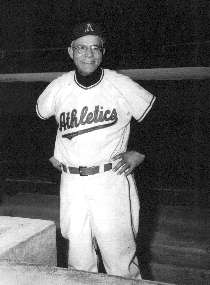
Bing Miller finished his playing career with a .311 batting average, 1,934 base hits, 116 home runs and 990 RBI. He had hit over .300 eight times. He is in baseball’s top 100 in both career batting average and sacrifice hits. Bing Miller, however, wasn’t through with baseball, he was just getting started. His reputation as “Old Reliable” and his skills made him a perfect coaching candidate. Bing coached the Red Sox from 1937 to 1938 and the Detroit Tigers from 1939 to 1941. In 1942 he rejoined old teammate Jimmy Dykes and his Chicago While Sox and coached through the 1948 season. In 1950 Bing once again joined Connie Mack as Connie celebrated his Golden Jubilee and remained a coach through the 1953 season.
Like several members of the 1929-1931 Philadelphia Athletics, Bing Miller died before his time. Al Simmons had died at age 56. Jimmie Foxx was 59. On May 7, 1966, 71 year old Bing Miller was injured in an auto accident while driving home after attending Connie Mack Stadium for a game between the Phillies and Pirates. Taken to Presbyterian Hospital in Philadelphia, the Wynnewood, PA resident died six hours after the accident.
At the scene of the accident, a policeman found a diamond tie clasp. It had the inscription “1930 World Champions”. Bing Miller had kept the Philadelphia Athletics close to his heart. Seventy one years of age might sound like a full life to most people. As with his baseball career, however, Old Reliable probably felt like he was just getting started.