BILL WERBER: RUNNING THE GOOD RACE
 By Dale B. Smith
Bill Werber has been running a race. The course has been varied and challenging. His pace has seen him sprint, jog and occasionally walk but never stop. The amazing thing about Bill Werber is that he has been running this race for nearly 100 years, longer than any other living major league baseball player. In the race of life, despite numerous accolades of “well done” throughout his various careers, Bill Werber keeps going and going.
The race began June 20, 1908 in Berwyn, Maryland near Washington D.C. Young William Murray Werber was out of the starting gate. In 2001, ninety three years later, Bill Werber found time to write an autobiography Memories of a Ballplayer about his baseball experiences in the 1930s. And today the race continues toward 2008.
But let’s go back a bit to 1927. The ever achieving Werber, an All-American basketball player at Duke University, was a freshman at Duke when he was “signed” by the New York Yankees and traveled with the storied 1927 team for awhile that year. Bill, however, decided that this pace was much too fast and backed off, returning to Duke to finish his degree. By 1930 Werber had graduated from Duke and reported back to the Yankees, playing a total of four games and getting four base hits. Again, he had come on too quick and went back to the minors for more experience.
By 1933 Bill was back again with the Yankees and competing for a position at SS. But with Frankie Crosetti getting established at that position, the Yankees traded Werber to the Boston Red Sox. Playing both SS and 3rd Base, the rookie made an impression by getting 110 hits and batting .258. The Red Sox, however, finished in 7th place.
It was in1934 when the second year player literally broke away from the pack. Playing in 152 games for the Red Sox, the 26 year old Werber got 200 hits, scoring 129 runs and hitting .321. Bill led both leagues in stolen bases with 40, 12 more than the next highest number of steals. Bill started developing a reputation as having the best legs in baseball. As with many young players, the ability to play every day at a starting position was satisfying enough. And Boston had improved from 7th to 4th place. But how long could the competitive Werber be satisfied, especially considering he had been raised a Yankee?
In 1935 the Boston Red Sox finished 4th again. Werber’s numbers fell to 118 hits while batting .255. He still led the AL in stolen bases with 29. By 1936, however, the Red Sox were moving backwards, finishing 6th although Bill improved to a .275 average and 147 hits. And then it got worse. The 28 year old former All-American, former Yankee, former stolen base king was traded to our beloved Philadelphia Athletics in December 1936.
It had taken only four years for the 1931 pennant winning Athletics to fall into last place in 1935, 34 games out of 1st. By 1936 they were in last again having lost 100 games and were now 49 games out of 1st.
There might have been some measure of optimism on the 1937 Philadelphia A’s. The Athletics had 2/3 of a solid outfield in Indian Bob Johnson and Wally Moses. Catching looked good with a 22 year old youngster named Frankie Hayes. Lou Finney at 1st had 197 hits in 1936 and Harry Kelley had posted 15 wins with a 3.87 ERA.
At the end of 1937, the A’s did go up a notch to 7th place. Moses and Johnson had great years. Bill Werber hit a solid .292 with 144 hits, 70 RBI and led the league again with 35 stolen bases. Harry Kelly again led the Athletics with 13 wins. His 21 losses and 5.36 ERA, however, told the pitching story.
In 1938 the 30 year old Weber was now becoming a senior member of the squad and watched his team fall back into last place despite continued production from Wally Moses and Bob Johnson and promising starts from a couple of 22 year olds; Sam Chapman and Dario Lodigiani. Werber’s 129 hits and .259 average were certainly below his expectations. In runner’s terms, perhaps Bill had hit “the wall”.
The 1939 season was looking like it would be more of the same. But after Bill Werber held out for a raise, manager/owner Connie Mack decided to sell Werber to the Cincinnati Reds. And just like that, Bill Werber got a second wind.
The 1938 Reds had finished in 4th place in the NL but only 6 games out of 1st. At 31 year of age, Werber was able to provide leadership and aggressiveness to the talented Reds who featured Frank McCormick, Ernie Lombardi and a top-notch pitching staff in Bucky Walters and Paul Derringer. One of the younger players on the team was a 2nd Base/SS player named Eddie Joost.
In 1939 the Cincinnati Reds stormed to the pennant, winning 97 games and finishing in 1st, 4.5 games ahead of 2nd place St. Louis. Bill Werber hit .289, led the league with 115 runs and was 2nd on the team with 173 hits. In one season Bill had gone from worst to first. Although the Reds were swept in the 1939 World Series by the New York Yankees (Bill hit .250) he was now so close to a World Series ring he could not be satisfied until he put one on his finger.
In 1940 almost the entire Reds starting lineup was back. Again Walters and Derringer had great years. The Cincinnati Reds won 100 games and finished in 1st again, this time by 12 games over the Dodgers. Again Bill Werber had a solid year hitting .277, getting 162 hits and scoring 105 runs. This time the World Series opponent would be the Detroit Tigers.
The Series went back and forth through seven games. While Frank McCormick and Jimmie Ripple provided 7th inning heroics in the Reds 2-1 victory, it was Bill Werber who put on a hitting clinic during the Series while hitting in the leadoff position. Bill led the Reds with 10 hits, five runs and hit .370. In two short years Bill had gone from a forlorn member of a last place team to a World Series Champion.
1941 and 1942 proved to be less productive years for Werber and after 1942, at 34 years of age, Bill was through with the major leagues.
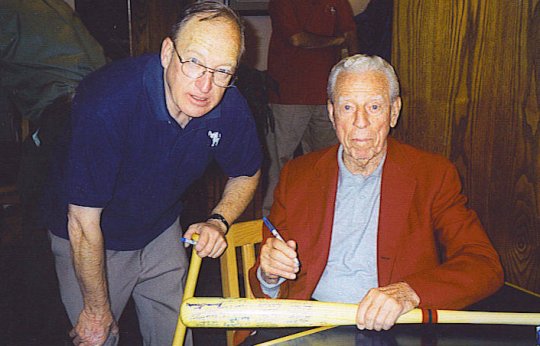
So what does a super-achiever do after a distinguished baseball career and a World Series ring? Keep running the good race of course. With his hard work ethic, Bill Werber had a very successful career selling pension plans and overseeing the Werber Insurance Agency. He also found time to donate to the Boy Scouts and spearheaded many activities with his alma matter Duke University. He became a member of the Cincinnati Reds Hall of Fame in 1961. When retired, he often kept involved as a public speaker and in 2001 was the keynote speaker at the Philadelphia Athletics Historical Society’s Annual Breakfast. On July 22, 2007, with the death of Rollie Stiles, Bill Werber became the oldest living major league baseball player at 99.
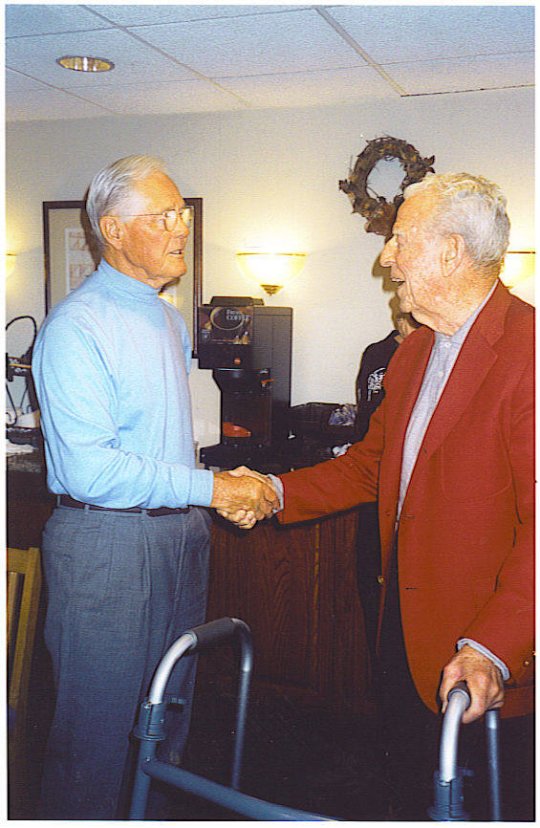
Although Bill Werber spends most of his time in a wheelchair these days, he is still running the good race in a North Carolina retirement home where he reads books and writes letters.
Often a baseball player will retire and rest on his laurels. Bill Werber, however, has never taken a rest. He keeps going, only at a slower pace now. Bill Werber is not finished with the good race, he is still running it. Well done.