Baseball Clowns at the 1930 World Series
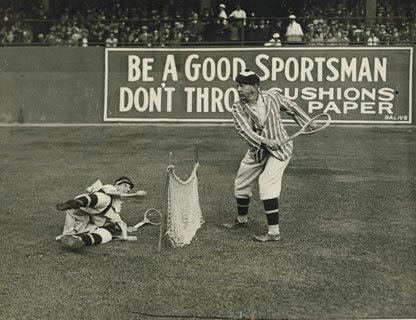 By Bob Warrington
Entertaining fans at a ballpark with activities other than playing the actual ballgame has long been a part of baseball. Many years before the Phillie Phanatic made his appearance, baseball clowns were hired by team owners to entertain crowds before games and between the innings. Clubs wanted their fans to laugh, both to break the tension a game might create and to reinforce the impression that one could have a good time at the ballpark—even if the hometown crew didn’t emerge victorious.
According to an article on early baseball clowns written by Hank Thomas for the Washington Baseball Historical Society’s newsletter (“Nats News,” Number 22, pp. 9-10), “Germany” Schaefer was the first true practitioner of the art. A mediocre player, Schaefer displayed far more talent making crowds laugh with his wild imitations of an umpire’s play calling, impromptu speeches to spectators, and walking the baselines as if they were tightropes. In 1912, Shaefer teamed up with Nick Altrock to create some fun at the Washington Nationals ballpark. The partnership ended, however, when Shaefer defected to the Federal league in 1915.
Altrock performed a solo act for the Nationals until 1921, when he teamed up with Al Schacht, a sore-armed pitcher, who, like Altrock, became a coach for Washington. For the next 15 years, according to Thomas’s article, the two “gained national fame by performing an endless variety of skits and satires of famous people and events of the day at every conceivable venue, including the World Series and All Star games.”
The wire photo that accompanies this story shows Altrock and Schacht at Shibe Park performing one of their skits before the first game of the 1930 World Series. They appear to be playing some outlandish form of badminton. Altrock is in the ground looking up at Schacht. America was in the gripe of the Great Depression when the 1930 World Series took place, and the crowd almost certainly needed a few laughs to forget about the country’s economic woes. The Depression would get worse before it got better.
The write-up on the back of the photo notes the date, 1 October 1930, and comments that “the two noted baseball comedians put in their appearance; namely Al Schacht and Nick Altrock.” The write-up also observes that the “Athletics win the initial game of the World’s Series.” The game summary it provides highlights the following, “Although out hit by their National League rivals 9 to 5 in the opening game of the World’s Series at Shibe Park, the Philadelphia Athletics came through to win by the score of 5 to 2. The game was featured by the home runs of Al Simmons and Mickey Cochrane. Grove, who did the twirling for the A’s, kept the nine hits well scattered to win the opening game of the classic. Grimes was the pitching choice of the Cardinals.”
The photo is significant for one other reason. In the background there is a large sign placed on the outfield wall that reads, “Be A Good Sportsman. Don’t Throw Cushions & Paper.” Connie Mack did not believe in cluttering Shibe Park’s outfield walls with advertising or any other type of signage, judging it detracted from the aesthetic quality of the ballpark. The appearance of a sign on Shibe Park’s outfield walls is most unusual.
We can only presume that the intense passions and fierce team loyalties ignited by World Series games prompted Athletics’ management to place the sign as a reminder to spectators to behave themselves during the game, even if incensed by some outrageous incident, like an umpire calling an A’s player out when it was obvious to everyone else in the ballpark that he was safe. Perhaps previous incidents of fans’ venting their displeasure by throwing objects on the field during a game prompted the Athletics to post the sign.
Patrons at Shibe Park could rent cushions for ten cents to soften the experience of sitting through a game. Covered in hard leather, there’s no doubt they made handy objects to throw to register one’s objections and disgust over game developments.
As noted, the Athletics sent hometown fans home happy by beating the Cardinals in Game One of the 1930 Series. A’s fans would have even more to cheer about a week later on 8 October 1930 when the White Elephants won the sixth and deciding game of the Series at Shibe Park by a score of 7 to 1.