An Election Eve Gathering of Philadelphia Sports’ Leaders
 By Bob Warrington
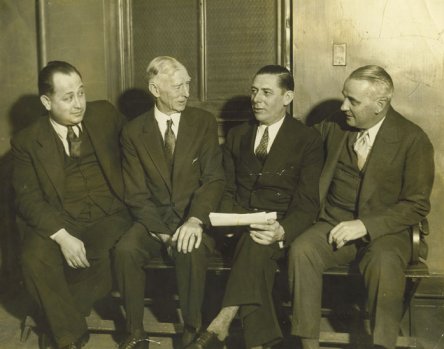
The photograph that accompanies this story was taken on 4 November 1933 and shows, from left to right, Eddie Gottleib, Connie Mack, Louis Schwartz, and Gerry Nugent. The photo’s significance derives from the reason these men were meeting. It was the eve of a momentous change in the conduct of professional sports in Philadelphia.
Three of the men—Mack, Nugent, and Gottleib—occupy important places in Philadelphia’s sports history. Mack and Nugent, of course, are known through their connections to major league baseball in the city. When this photo was taken, Mack had just finished his 33rd year as manager of the Philadelphia Athletics, a position he would hold for another 17 years. Nugent had just completed his second year as president of the Philadelphia Phillies, a position he would hold for another 10 years.
Eddie Gottleib’s role in Philadelphia’s sports scene focused primarily on basketball, and he was a major figure in the city from the 1920s into the 1960s. As historian Rich Wescott writes, “Eddie Gottleib parlayed a shrewd mind and a hankering for action into a long career as a sports entrepreneur.” Gottleib’s multiple, important contributions to Philadelphia’s sports history are chronicled by Westcott in his book, “A Century of Philadelphia Sports,” (Philadelphia: Temple University Press, 2001), and readers are encouraged to consult that book to find out more about Gottleib. A listing of some of Gottleib’s many accomplishments, taken from Westcott’s book, include:
Coached Philadelphia Textile’s basketball team for two years in the mid-1920s.
Financed the creation and helped oversee the operations of the Philadelphia Stars Negro National League baseball team. Formed in 1933, the Stars held an important place in black baseball until 1952.
Organized and played for the South Philadelphia Hebrew Association (SPHAS) basketball team in the mid-1920s. The team joined the Eastern Basketball League—one of the top professional circuits in the country—in the early 1930s. The SPHAS later joined the American Basketball Association (ABA), and Gottleib’s teams won ABA titles in 1940-43 and 1945.
First coach and general manager of the Philadelphia Warriors basketball team, which was a charter member of the Basketball Association of America (BAA). Gottleib was one of the founders of the BAA and was instrumental in obtaining a franchise for Philadelphia. Under Gottleib, the Warriors won the first BAA championship in 1946-47. The Warriors, with Gottleib as their owner, also won the National Basketball Association (successor to the BAA) championship in 1955-56. Gottleib moved the Warriors to San Francisco after the 1961-62 season.
A Key Election Vote Nears
On 7 November 1933, three days after this photo was taken, Philadelphia voters would go to the polls to decide whether to permit professional sports to be played in the city on Sundays. The Athletics had been campaigning for permission to play baseball games on Sunday in Philadelphia since 1911, recognizing the money-making potential of Sunday games. The story of the A’s fight for Sunday baseball—a long and arduous endeavor—was told in a two-part series that appeared in the A’s Society’s newsletter, “Along the Elephant Trail” (Issue 17, No. 7, July 1998; and Issue 18, No. 8, August 1998).
After years of frustration in seeking their goal, things were looking up for the Athletics in 1933. In April of that year, the Pennsylvania House and Senate passed a bill—then signed by the governor—that allowed local jurisdictions to determine by voter ballot whether Sunday professional sports and other amusements could take place within their jurisdictions. Voting would occur in November 1933.
But, how can we be sure in looking at the accompanying photo that Mack, Nugent, and Gottleib are likely discussing the upcoming vote? The presence of the fourth man in the photo provides a strong indication that is exactly what was taking place. He is Louis Schwartz, a state representative whose district was in Philadelphia. State representatives with districts in Philadelphia had long been on board with the Athletics in pushing to legalize professional sports on Sundays. Schwartz was Mack’s principal point man in Harrisburg pushing the initiative.
Indeed, Schwartz wasn’t above a little subterfuge in getting the bill passed. In 1931, he introduced a seemingly innocuous bill to move the hours for delivery of milk on Sundays from 9 AM to 10 AM during the months of day light savings time. As the milk bill gathered support, Clinton A. Sowers, also a state representative based in Philadelphia, attached a rider to it at the last moment to permit baseball on Sunday afternoons. The baseball rider caused a tumultuous response from opponents of Sunday baseball. Debate on the issue was fierce as Sabbatarians aroused just enough opposition to defeat the Schwartz bill.
But, time and tides were on the side of the pro-Sunday sports lobby. With America in the grips of the Great Depression in 1933, Governor Pinchot of Pennsylvania garnered support for the bill by promising that 10 percent of the taxes collected on Sunday admissions to professional sports events would go to unemployment relief.
In addition, the National Football League pledged in 1933 to put franchises in Philadelphia and Pittsburgh only if Pennsylvania eliminated of its ban on Sunday professional sports. The state’s eagerness to obtain professional football clubs within its borders added an extra incentive to do away with the prohibition.
If the men in the photo appear to be in good spirits, there was ample reason for them to be so. All signs pointed to overwhelming approval by Philadelphia voters to overturn the ban on Sunday professional sports within the city’s jurisdiction. In fact, voters approved the measure by a 5-1 margin. Although Mack and the Philadelphia Athletics had led the charge to scrap the prohibition, Nugent and Gottleib were behind the initiative because the organizations they ran also stood to profit financially from playing games on Sundays.
Connie Mack was most appreciative of Louis Schwartz’s efforts to get the bill legalizing professional sports on Sunday passed by the state legislature. Following the affirmative vote by Philadelphians in November 1933 to permit such games, the first legal Sunday game was played in the city on April 22, 1934 in a contest that pit the Athletics against the Washington Senators. The A’s, according to Charlie Bevis, in his book, “Sunday Baseball” declared it Louis Schwartz Day at Shibe Park “to honor the man that had championed the Sunday baseball bill through the Pennsylvania legislature.” The club gave Schwartz a silver loving cup before losing to the Senators 4-3 on a chilly day in front of 20,306 fans.
Professional teams playing games on Sundays have become a regular feature of Philadelphia’s—and the Nation’s—sports scene. This photo shows the dawning of that era, and it shows the men who did so much to make it happen. It is a significant photo of significant men taken at a significant time. The photo is available for sale from the A’s Society.
Postscript: Louis Schwartz’s son, George X. Schwartz, was a prominent member of the Philadelphia City Council and was a major player in decisions involving the location, construction, financing, and naming of the stadium being built for the Phillies so the club could escape the archaic confines of Connie Mack Stadium. The new facility built in South Philadelphia came to be called Veterans Stadium and was the Phillies’ home for 33 years.
George X Schwartz was a Democrat. My Uncle Louie has a daughter Martha who married Billy Perez
jim schwartz, (Uncle Louie was my great uncle)